Category: Culture

Sticking Up For Singlish


A Sticky Piece Of Gum

It took a semester away from Singapore for local graphic designer Ray Han to begin to wonder what it meant to be a Singaporean. While on exchange as a student at Maryland Institute College of Art, the recent graduate of NTU’s School of Art, Design and Media (ADM) realised how little people understood and knew about Singapore. This is why she created A Piece of Gum. A Peace of Gum, an illustrated book about Singlish, for her final-year project that was showcased in the recent ADM Grad Show 2010.

“I decide to work on Singlish. because I believed that it is the only non state engineered piece of culture and is an organic fusion of the diversity,” says Ray over an e-mail interview.

Putting together the English reference to “bubble gum” which is banned here, along with the similar sounding Hokkien word “gum”, meaning the ability to live in harmony, Ray has put together a visual book with minimal text but lots of visual metaphors to tell the story of Singlish — a language created out of the diversity of peoples here, and has helped to bring them together.

DSC_1829

This book is Ray’s first step in a quest to create a timeless design that represents the collective identity of Singaporeans. “I think Singaporeans born and lived in Singapore will always have their identity with them, because we grow, breathe, talk and eat here,” she says. “I believe the identity is formed without them knowing.”

She hopes that this book will help readers discover Singapore culture from a graphic designer’s point of view, and she’ll love to see it publish one day. For Ray, infusing national identity into their design is a matter of choice. “The decision to represent the collective identity excites me, and designers who are equally interested in this area can help bring knowledge for the world to understand and appreciate our roots, and stories,” she says.

StickyPeace

Now that she has graduated, designing will have to take a backseat for Ray. She is on a Ministry of Education scholarship, and will be teaching for the next four years. However, she will continue designing and one day start up her own design label.

Find out more about Ray and her book, A Piece of Gum, at <http://theraybit.com>

Bridging the Disconnect with Design


DSC_1846DSC_1852

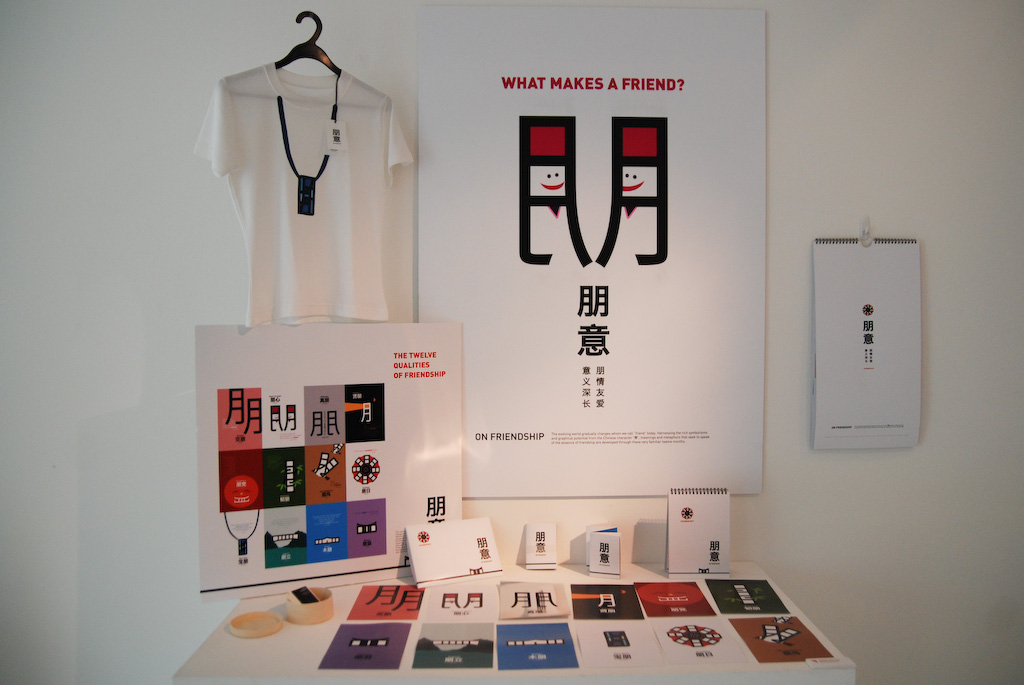
Look 喜喜 by Ang Tze Qi and 玩: Traditional Chinese Games by Cheong Jia Qi

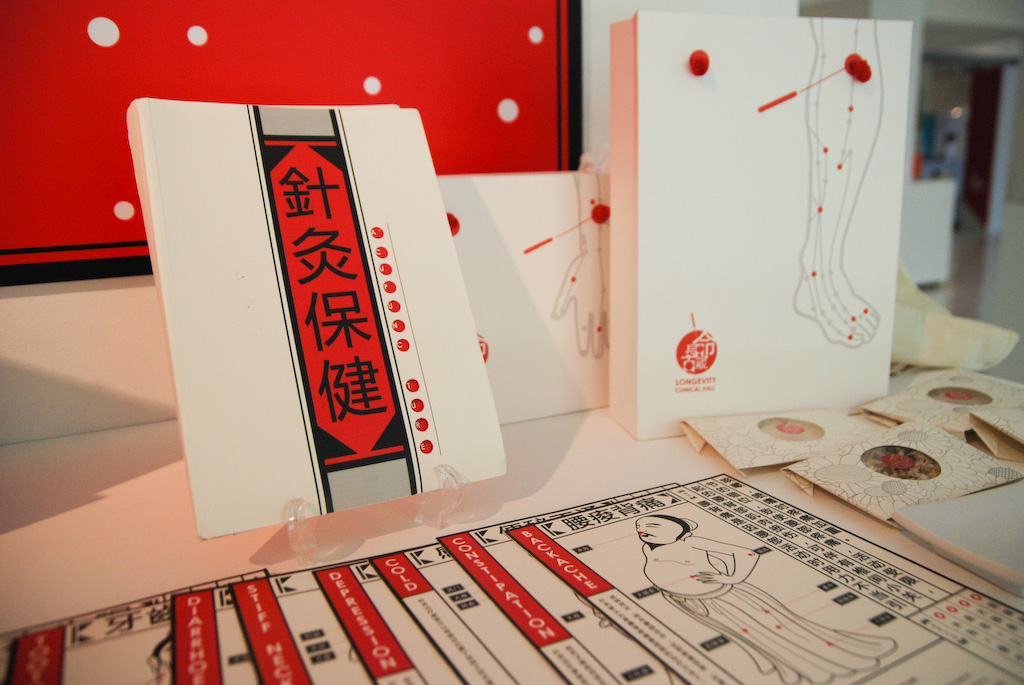
Old is gold, or so it seems, for this year’s visual communication graduates of the School of Arts, Design and Media (ADM) in the Nanyang Technological University. Most of their final-year projects on display at the ADM Grad Show 2010 were the re-packing of old traditions and cultures in new visual forms. Some of the subjects “re-designed” included Hakka culture, traditional Chinese games, Chinese wedding customs, Kimonos, the Chinese peony and Feng Shui.

DSC_1837DSC_1848

Hakka Culture by Alvin Leu and Creation and Metamorphosis of Chinese Hanzi by Low Weining Kasxier

This popular choice amongst our young local designers of mining heritage for design seems to reflect a certain disconnect between our youth and the old in Singapore. The traditions and customs of yesteryear are seen as strange and inaccessible to today’s youth, and the response of these curious young designers is to redesign them. This is also a strategy employed by museums here, notably the National Museum of Singapore. Since its re-opening in 2006, the museum has employed graphic design to package history in edgy visuals to attract the younger generation. Some of that energy and approach must have rubbed off  this batch of graduates.

Interestingly, many of the works also centered around Chinese culture. The use of ‘trendy’ designs and English as the language of choice suggest that these projects are created for an English-speaking audience. Again, we see design being used to bridge another Singapore disconnect — that of the English-speaking graduate class and their curiosity with their ethnic culture. Here, we can also see ‘who’ graphic designers are in Singapore — mostly Chinese.

DSC_1844DSC_1836

五行 by Lam Si Yun and 朋: What Makes a Friend by Wang Shi Hui

While, the youth may take a liking to how heritage has been repackaged for them in these forms, it’ll be interesting to see this collection of projects put to the older generation as well. Will they be able to comprehend these ‘edgy’ designs? And will they think that such repackaging has “consumerise” their cultures — a sell-out, perhaps?

DSC_1839

Longevity by Low Lay Hiang

How Will We Picture Our Past?

After doing some work recently involving the use of images of Singapore’s past, I’ve learnt that there are only three sources for old images: PICAS, Singapore Press Holdings (SPH) and personal collections.

PICAS is the Picture Archives Singapore Database run by the National Archives of Singapore (NAS) that contains some of the oldest photographs of Singapore. To buy a photo from the database is just as archaic. You cannot buy a photo online. Instead, you fill up a form and place your order at NAS itself, and return to collect the actual print. The only plus point is that you pay much less for a photo from PICAS, as compared to SPH, if you’re publishing for educational and cultural purposes.

While PICAS may have the oldest photographs, SPH has the most extensive collection of images of Singapore’s past. In fact, many images in the PICAS database actually belong to SPH. This means you have to deal with SPH and pay their rates if you want to use the SPH photos. Their extensive database is no surprise as SPH is a news organisation that covers all the important events of our nation’s lifetime. While it has an online SPH Photobank System, that database only carries current photos. To see all the old photos SPH has, you have to make an appointment to go down to their Information Resource Centre to search their internal servers.

The final resource for old images of Singapore is an emerging one thanks to the proliferation of digital imaging tools. People can now easily put up their personal collection of photographs and there are many gems out there waiting to be discovered. The National Library Board (NLB) is making an effort to canvass these photos and make them available via it’s Singapore National Album of Pictures (SNAP) website. It has also created a Flickr! set too. The only issue is with regards to their use. I have no idea if I can somehow obtain these photos for publishing. Another collection that exists online is Memories of Singapore, which is made up largely of photo collections from expatriates. Interestingly, the photos also give a glimpse of an expatriates’ life in Singapore in the past.

The problem with the current offerings of image databases is their poor quality and how there are so few of them. This limits the view of our colourful and diverse past, such that after a while, the same few ‘classic’ photos are reused to depict Singapore’s history. While SPH has built up the most extensive database, public access to it is troublesome, and the cost of use is prohibitive. PICAS is disappointing, and it could do so much better in terms of collection and the simple task of enabling online payment. I’m also a little puzzled as to why I wonder NLB is spearheading SNAP instead of NAS.

More importantly, I think there are a lack of image databases in Singapore and we’re depending too much on a few big institutions to document our lives. Especially nowadays, when there are so many event photographers and amateur photographers covering public life in Singapore. What is lacking are organisations and people who can amass these photographs, make sense of them, and make them available online so that future generations, and even you and I, can better remember what life is like today.