Amidst the grand plan for a global city called Singapore is the small neighbourhood of Tiong Bahru, a place I like to go home to one day.
This is a piece I recently contributed to the project Civic Life Tiong Bahru.
Amidst the grand plan for a global city called Singapore is the small neighbourhood of Tiong Bahru, a place I like to go home to one day.
This is a piece I recently contributed to the project Civic Life Tiong Bahru.
The magazine market with its quick turnaround and fierce competition has always been a fertile ground for creativity. This is a latest incarnation (ok, I’m a little late in discovering this) of a magazine: Kult’s ArtCade Machine — 3D Magazine. It merges a magazine with a 80’s arcade machine!

 KULT
KULT
Kult, is a free printed quarterly magazine by a local creative agency of the same name that uses visual culture to explore issues of our society today. The ArtCade was created for its launch issue last year that explored the theme of “Trust”.
In its second issue, Kult looked at the “Artificial” and also created an interactive online version of its magazine. Unfortunately, it is offline currently. The magazine edited by Brendan Graham and art directed by Steve Lawler recently published its third issue, which features some 29 illustrations by artists from all around the world that looks at the health epidemic AIDS. Compared to the first two issues, which came in forms that explored new boundaries in magazine publishing, this is a little bit more regular, but still an interesting read.
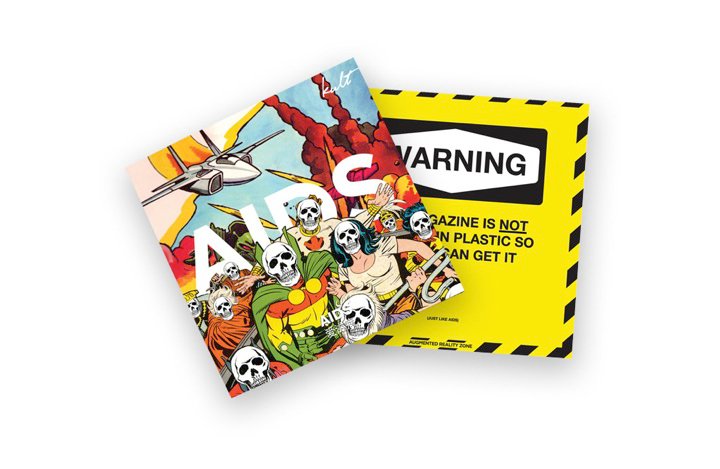 KULT
KULT
Kult isn’t the first local magazine that devotes itself to use visual culture to explore issues. In fact, its art director Steve worked on the last issue of a now defunct local magazine FL.ag that runs on the same concept. Interestingly, the issue of FL.ag that Steve worked on also looked at AIDS and its cover image is the same one done by Austin Cowdall found inside this issue of Kult.
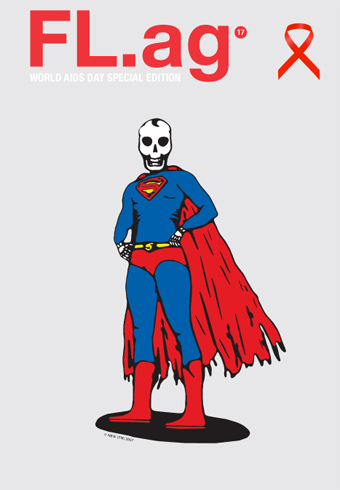 FL.ag
FL.ag
An empty piece of land is not something that will catch our eye as we go about our daily lives, but for photographer Darren Soh, it sparked his on-going project that documents the building of Marina Bay Sands. Presenting at the inaugural PLATFORM, Darren showed a full-house crowd at Sinema his “progress pictures” of the integrated resort since construction began some four years ago. The photographer, who has made several photo collections of the Singapore landscape, said this island is one big construction site and that makes emptiness in Singapore’s landscape significant and something worth documenting.
Indeed, living in a country where everything is so transient, Singapore’s landscape has been extensively photographed. However, most works on it that I’ve seen focuses on the death of landscapes and its decay. It’s become a knee-jerk reaction for photographers living here — just look at the number of photographers who have been flocking down to Tanjong Pagar Railway Station now that it’s future is in limbo. Darren’s project responds to this Singapore condition from a different time frame — its beginning and birth. More importantly, his project freezes the never-ending construction work that we are seemingly surrounded with and allows us to reflect, and even marvel, the building of Singapore.
Coincidentally, I recently had the privilege of helping do some background research for an architectural project that looks at the conditions of emptiness in Singapore. The findings of architect Thomas Kong’s project will be presented in ‘Zero’: Alternative Scenarios for Architecture in a Post-Bubble Era on 16 June in Rotterdam.
As a number, zero is neither negative nor positive but we often assign a degree of negativity despite its neutral meaning. A vacated site similarly lies in a liminal state with potentiality. However, architects have been taught that the only thing they could present to society is a building, to fill the void again. But what can they learn from the way in which individuals and groups appropriate empty sites in towns and cities? And in broader perspective, what can zero offer as we live through the Great Recession, when the myth of continuous economic growth is shattered, the assumption of ready capital for development can no longer be guaranteed and architecture students are taught only one mode of survival as a professional?