Category: Culture

Interpreting Typefaces of Singapore’s Newspaper Nameplates

A few posts ago, I introduced the typefaces of Singapore’s English newspaper nameplates and who else uses them. This time, I’ll interpret them and see if they might mean anything at all!

seeingnewspapers0002Barnhurst’s Seeing The Newspaper is a great book on visual journalism and in one chapter, he looks at typography and meaning through a typeface’s origins in history and its use in that society.

The meanings assigned to type by readers and typographers seem to spring not form some objective code but from the cultural experience common to both groups.
Barnhurst, Seeing The Newspaper, p.155

With his words in mind, here is my take on the nameplates!

stnameplate

Typeface: Big Caslon (Straits Times)

Based on a humanistic handwriting by printers in Italy before 1500, Big Caslon is a modern day recreation of the original typeface by William Caslon of England in 1725. Back then, Caslon was very popular and even used in the US Declaration of Independence. The saying went, “when in doubt, use Caslon”. It seems appropriate for ST to use such a historic and serious typeface as “the paper of record” but it is also a safe and un-imaginative choice.

todaynameplate

Typeface: Times New Roman

The default typeface in Microsoft Word for several years, Times New Roman was created by Stanely Morison and Victor Lardent for London’s The Times newspaper in 1931. It’s hard to go wrong with a typeface designed for newspapers but its ubiquity also suggests that TODAY was not really thinking out of the box. And for some reason, to be a serious newspaper here, you have to use a British typeface.

tnpnameplate

Typeface: Helvetica Neue (The New Paper)

Perhaps the most well-known popular typeface today, Helvetica was created as a neutral sans serif typeface that had great clarity and no intrinsic meaning. Indeed, TNP’s choice of this Swiss typeface reflects its readership and news — simple and familiar to the masses. There is no need for frills when this tabloid’s content is already full of sex, violence, gossip, soccer…

btnameplate

Typeface: Frutiger

Sans serif typefaces, like this one, came about in the 19th century and was first used in advertising displays. This particular one is another Swiss typeface and designed by Adrian Frutiger for directional signs for an international airport in France.

What better way to report about business by using a typeface they made their own? This one has an international appeal to boot too.
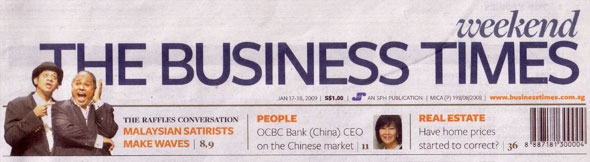
btweekendnameplate

Typeface: Freight Sans

Being part of The Business Times, this nameplate cannot deviate a lot from its main paper. The choice of this pretty new typeface seems like a update with the times plus a touch of lightness for the weekend crowd. The typeface’s creator Joshua Darden says Freight Sans is “designed for warm formality in text and an authoritative, helpful tone in display” — indeed.

mypapernameplate

Typeface: Myriad

Used by Apple Computer since 2002, this paper probably wants to identify itself with the younger generation, so speak the language of one of the most popular brands amongst the youth today?

sundaytimesnameplate

Typeface: TheSans

It’s Sunday and the last thing you want is to be greeted by a serious paper the first thing in the morning. Thus, the choice of this typeface by Dutch designer Luc(as) de Groot seems appropriate since it is marketed as a “useful-yet-friendly, all-purpose contemporary sans-serif”. Until you realise it is also “the face of thousands of organisations, publications and web sites”, but then it has to stay safe like its main paper, The Straits Times, too.

I Want to Write

About ordinary things

The door is a crossing, a junction marking the divide between the realm of the public and the private, between the chaos of the unformed world outside and the sacrosanct order within and, as such, it is a symbolic moment which needs to be marked.

Edwin Heathcote, Making an entrance

About relationships

In the best comic books and graphic novels, movement is the deferred magic that gives the pages their dormant power and dynamism. In the greatest cinema, stillness is the magic to which motion nostalgically, primally aspires to return. That is why the relationship between the two forms, though it may never be a marriage, will always be alive, mysterious and passionate as a romance.

Nigel AndrewsThe relationship between cinema and comics

With passion

Like everything that you and the institution of television touch is destroyed. You’re television incarnate… indifferent to suffering, insensitive to joy. All of life is reduced to the common rubble of banality. War, murder, death… are all the same to you as bottles of beer. And the daily business of life is a corrupt comedy. You even shatter the sensations of time and space into split seconds and instant replays. You’re madness… virulent madness, and everything you touch dies with you.

Max, the old guard News Division editor, to Diana, the nubile young television programming executive, when breaking up with her in the film Network (1976)

The truth

The world is a college of corporations inexorably determined by the immutable bylaws of business. The world is a business. It has been since man crawled out of slime. And our children will live to see that perfect world in which there is no war or famine, oppression or brutality. One vast and ecumenical holding company for whom all men will work to serve a common profit in which all men will hold a share of stock, all necessities provided, all anxieties tranquilised, all boredom amused.

Arthur explains the new world to Howard in the film Network (1976)

The damm ugly truth

We’re in the boredom-killing business. So if you want the truth, go to God. Go to your gurus. Go to yourselves! Because that’s the only place you’re ever gonna find any real truth. But, man, you’re never gonna get any truth from us. We’ll tell you anything you wanna hear. We lie like hell. We’ll tell you any shit you want to hear! We deal in illusions. None of it is true!

But you people sit there day after day, night after night. All ages, colours, creeds. We’re all you know. You’re beginning to believe the illusions we’re spinning here. You’re beginning to think the tube is reality and your own lives are unreal. You do whatever the tube tells you! You dress like the tube, eat like the tube, raise your children like the tube, even think like the tube. This is mass madness, you maniacs! In God’s name, you people are the real thing! We are the illusion! So turn off your television sets. Turn them off right now.

Howard explaining the television business to his audience in the film Network (1976)

Typefaces of Singapore Newspaper Nameplates

Here’s a list of the nameplates of Singapore’s english newspapers and what typefaces they use. I’ve also included popular contemporary references that also use the same typeface, maybe the choice of usage says something about the paper?

stnameplate

Typeface: Big Caslon (Straits Times)
You might have seen it: Foreign Affairs (headline) and The New Yorker (body text)
tnpnameplate

Typeface: Helvetica Neue (The New Paper)
You might have seen it: Everywhere (even a film made about it)

btnameplate

Typeface: Frutiger
You might have seen it: National University of Singapore

btweekendnameplate

Typeface: Freight Sans (The Business Times)
You might have seen it: Reader’s Digest (logo)

mypapernameplate

Typeface: Myriad (my paper)
Also used by: Apple Inc

sundaytimesnameplate

Typeface: TheSans
You might have seen it: Sprint

todaynameplate

Typeface: Times New Roman
You might have seen it: Default font for Microsoft Word prior to Microsoft Office 2007