Category: Design

#ADesignLibrary: 石汉瑞启蒙者 (Henry Steiner: Graphic Communicator) (2019)

Before design became globalised, some practitioners advocated for a cross-cultural approach that combined modernism’s international ambitions with local sensibilities. 石汉瑞:启蒙者 (Henry Steiner: Graphic Communicator) (2019) brings together the works, essays and interviews of one such trailblazer. The Vienna-born Steiner brought the modern graphic design principles he learnt from Paul Rand in New York to Hong Kong in the mid-1960s just in time for the city’s economic takeoff. By playing off cultural opposites of West and East, he showed one way modernist design ideas were adopted and adapted in Asia. While Steiner‘s works have been published in English, this comprehensive collection, edited by 何东, is entirely in Chinese and introduces him to a new generation and geography. It was published for a 2019 Steiner retrospective curated by designer He Jianping (何见平), who also designed this book.

#ADesignLibrary spotlights lesser known design books, and invites public access to my personal collection of titles that focuses on Singapore architecture and design, Asian design, everyday design, critical and speculative design as well as design theory and philosophy. I welcome inquiries and physical loans.
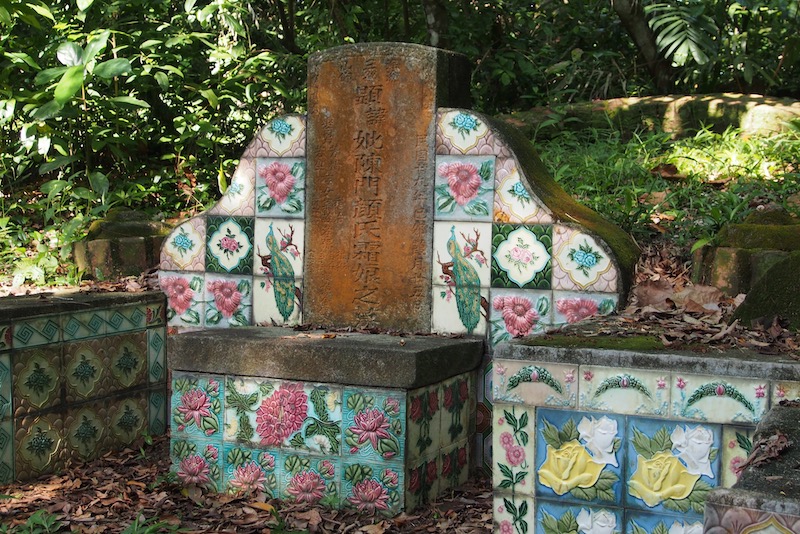
Discovering Singapore’s Heritage in Old Tiles

You will find them on bathroom walls, apartment floors and even on the facades of buildings. However, few would expect to encounter tiles in the cemetery. Artist Jennifer Lim was surprised by the colourful floral tiles that adorned her great-grandfather’s tombstone when she visited Bukit Brown Cemetery in 2012 to witness its exhumation.

The Australia-born had just moved to Singapore that year to learn about her Singaporean father’s Hokkien-Peranakan ancestry. As Lim retraced her family history in the city-state, she encountered similarly intricately designed ceramic tiles at the family’s shophouse in Chinatown and the nearby ancestral temple that her great-grandfather helped to found.

“With every place connected to my ancestors, these tiles would be like, ‘Hi!’,” recalls Lim.

➜ Read the full article in What’s Up (February 2020)

30 Years of Conservation: Science of Restoration

To ensure historic buildings last, we need to pay closer attention to the science of restoration, suggests Dr Yeo Kang Shua, a conservation expert.

Exposing an old building’s brick walls has become trendy to show its historic value. But this could be doing more harm than good, says Dr Yeo Kang Shua.

Not all bricks are fired to withstand the elements openly, and the contemporary practice of applying an adhesive to create such designs often damages a building in the long run.

As adhesives are hard and the bricks are soft in comparison, such walls will typically cave in over time, says Kang Shua, the Associate Professor of architectural history, theory and criticism at the Singapore University of Technology and Design.

Focus on materials

Such “purely aesthetic” practices may cause Singapore to lose its built historic fabric. Thus, Kang Shua has been advocating for a more scientific focus for restoration work. He first got interested in this topic while interning at RSP Architects Planners & Engineers, which was then restoring the Lian Shan Shuang Lin Monastery and the House of Tan Yeok Nee.

Since attaining his PhD in architecture history and theory at the National University of Singapore, Kang Shua has taken up a variety of roles as an academic, advocate and even practitioner — all with an eye on improving the profession’s understanding of the materials that make up Singapore’s historic buildings

“When we say restore back to original, at the end of the day, a temple looks like a temple, a church looks like a church, you do not change the motifs,” he says. “The question is how do you do it? How do you make sure there is no change? There is a lot of very grey areas.”

➜ Read the full story in 30 years of conservation in Singapore since 1989