Category: History

Wordless Instructions

Whether it is a chair, a shelf, or bed frame, every IKEA knock-down product is sold around the world with a similar assembly instructions design meant to be understood regardless of language, culture or experience in building furniture.
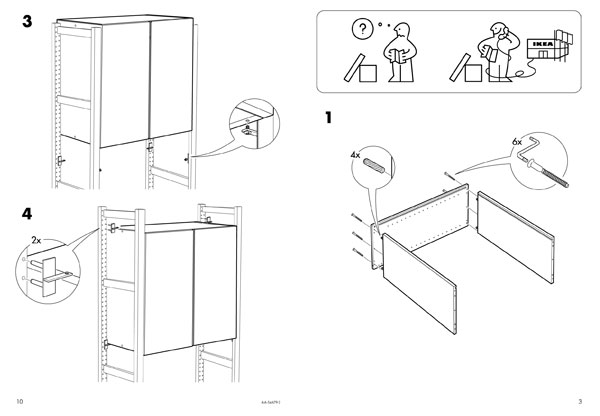
No words are needed when it comes to assembling a piece of IKEA furniture. Accompanying the Swedish company’s knock-down wares is a set of assembly instructions that must guide Russians, Americans, Chinese, Egyptians, Dominicans and other nationalities to build their own IKEA products simply by following a series of line drawings.

Every IKEA assembly instructions begins with a promise: an image of what the product looks like when put together successfully. A comic strip comes next, as a cartoon character gives out general tips, including an assurance that any doubts can be addressed by calling the company — although no number is given. After running through a check-list of tools provided, the customer is ready to begin self-assembly. Step-by-step, the following pages illustrate how the dismantled pack of parts are assembled into the product when the instructions are carried out.

This formulaic instructions design is what IKEA has been developing since launching the LÖVET side table in 1956, the company’s first self-assembled product. While no instructions were needed to put together this simple three-legged leaf-shaped table, the product kickstarted IKEA’s expansion into knock-down furniture and led to the birth of its assembly instructions. Founder Invar Kampard started selling such furniture in his mail-order business after seeing company designer Gillis Lundgren saw off the legs of a table to transport in his car. The Swedish entrepreneur realized the sale of knockdown furniture meant the most expensive parts of his business — assembly and transportation — were shared with customers instead. Read more
Spectator Sport: The Cartoons of Sham’s Saturday Smile

1980-ST-06-21-p31
Straits Times, 21 June 1980, p. 31.

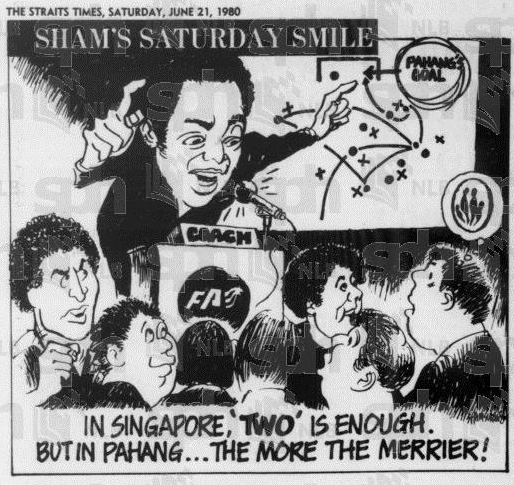
Die-hard Singapore football fans will proclaim the late 1970s and early 1980s as the best times for the national team. With the likes of “Gelek King” Dollah Kassim, the tough-tackling Samad Allapitchay, the Quah brothers and a then rising star in Fandi Ahmad, the team made it to seven consecutive Malaysia Cup finals and won twice. Their exhilarating performance on the pitch was captured in countless write-ups in the local newspapers, including a editorial cartoon in The Straits Times known as Sham’s Saturday Smile.

This creation of graphic artist Shamsuddin Haji Akib offered avid football fans fans like himself a punchline on Singapore football, bringing smiles to fans looking forward to Malaysia Cup matches every weekend. After a commentary on how the national team’s performance was being disrupted by coach Trevor Hartley’s ever-changing line-ups, Shamsuddin depicted him as a mad scientist who would not stop experimenting. Responding to various reported incidents of unruly behaviour amongst fans and players, he turned in cartoons with referees wearing helmets and Hartley learning the Malay art of self-defence, bersilat, to control his players.

Read more

The Chair That’s Everywhere

PHOTO: RAHMAN ROSLAN

The industry calls it the monobloc chair. To everyone else it’s that cheap plastic chair, the squarish, one-piece, stackable thing that populates the lawns and gardens of the world, so ubiquitous as to go unnoticed.

It seems to be everywhere: inside a storeroom in Florida, outside the Uruguay Pavilion at the Venice Biennale, and on a boat on the Zambezi River in Zambia, to mention just a few of the places the chair has been spotted, according to the Plastic Chair World Map. No one knows how many exist in their different versions or even who the original designer is, but they clearly number in the millions.

➜ Read the full story in Works That Work No. 10