Category: Media

Redesigning newspapers and why it matters

One point, or approximately 0.04 cm, was all it took for readers to find the recently redesigned Sunday Times a comfortable read again. After its redesign in April 2008,several readers complained that it was hard to read the paper’s body copy so designer Peter Thomas Williams increased its leading (amount of space between lines of text) from 11 point to 12 point and to his delight, the week after, a reader sent in an e-mail saying it was much easier to read it.

This is why Peter, who has redesigned ST (twice), The Sunday Times and designed tabla! and my paper, starts every project by working on the typography of its body copy. My Paper proved a challenge for the Irish because he had to design a newspaper that incorporated both the English and Chinese language. He did this by using similar colours and grid system, and picking matching typefaces that unified the disparate languages on to one paper.
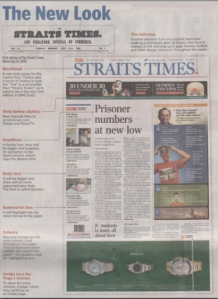
stredesignwhy1While he says that “proper” redesigns usually take up to a year, the recent ST redesign was done in six months, partly to coincide with the launch of ST’s new video news platform Razor TV.  A redesign should not be rushed because it is not just a matter of deciding on a new look but it takes time to introduce it to the sub-editors and into the computer systems, “You can’t just redesign a newspaper and walk away, the hard part is implementing it down the line.” he said.

But didn’t ST redesign in 2004? Peter said that newspapers today redesign every 2 to 3 years in an effort to stay relevant to its readers. In fact, in the most recent redesign, they considered reducing the nameplate to just “ST” because it was known to most of its readers as that.

On a daily basis, one of the biggest challenge in designing a page is working around advertisements says Peter, “The less ads the more beautiful your pages are going to be… SPH (papers) are full of ads.”. He pointed out that the winning designs awarded annually by the Society of News Design rarely have any advertisements on them, but the design editor of my paper is realistic, “That’s where we get our bonuses and your paycheck, so we can’t really complain that much.”

In the previous part of this interview, The Paginator asks Peter the importance of typography in news design and how the papers of Singapore Press Holdings chooses its typefaces


What type of newspaper are you?

stnameplate

A day before ST’s latest redesign launch, the typeface for its masthead was changed from Popular (only shred of it left is in ‘THE’) to Big Caslon, said Peter Thomas Williams who was part of the redesign team. While Popular failed to live up to its name, because it was thought to be “western” and “old-looking”, Peter, who is also design editor of my paper, said that the biggest factor when he chooses typefaces in his eight years of working in Singapore Press Holdings (SPH), is actually cost.

While he declined to go into specifics, one can do the math based on price lists online. Purchasing one typeface like Big Caslon for use on up to 1000 computers would already cost more than S$5,000. Considering the ST redesign itself involved about four typefaces, multiply that to the cost of installation for more than a thousand computers in SPH and one begins to see how cost becomes a major factor in his typeface choices.

tabla_logo

It was on such an “extreme budget” that led Peter, who used to work in a design consultancy in Ireland and as a visual communications lecturer in South Africa, to draw the nameplate of SPH’s Indian diaspora newspaper, Tabla, instead of purchasing a typeface. This was based on three different typefaces: Popular and Calvert for Tabla and the exclamation mark from Bauer Bodoni, which he felt looked like the Indian architectural style.

Costs aside, another important factor is the amount of space a typeface takes up, especially for use as body copy. If it is designed for newspaper use, a typeface is usually efficient in its space management, having a shorter x- and y- height (think shorter x and y and applied to all 26 letters) and kerning (space between letters) is even. A typeface that takes up too much space would mean story lengths have to be shortened to keep the same amount of news on a page. “If you choose a typeface that is beautiful but it is knocking off four paragraphs, it is useless.” he said.

A final factor in choosing a newspaper typeface is how intricate it is as newspapers are printed on paper quality that is “like toilet paper”.  Thus, a font with intricate serfis would not come out looking good as the ink is likely to seep causing such details to be lost.

In the next part of this interview, The Paginator asks Peter how it was like redesigning ST twice, The Sunday Times and My Paper.

FOUND: Visual Thinking and Thoughts

visual-thinking

This was how Peter Ong explained visual thinking in a 1994 AMIC paper where he also championed the importance of packaging and design so that newspapers stayed relevant to readers. The way to do so is to be, what I call, a total journalist.

According to Peter, such a journalist should:

  1. Integrate themselves fully into the design process
  2. Learn to think graphically
  3. Look for graphic potential in every story
  4. Collaborate with sub-editors and artists in the final packaging of their stories

The New Paper is one local English paper that I think has such journalists as one can see from how prominently they use infographics. I believe they are the only paper with the post of Infographic Journalist. You can see an archive of their works online here. Below are three of my favourites:

I love how this infographic not only served to categorise the price increases across different sectors but more also how it acted as a distinct visual element to convey the idea of price hikes so simply! Great layout too.

Here, the process of setting up the Singapore Flyer is well explained and readers get a sense of the scale of this world’s tallest observation wheel as it is compared with other megastructures around the world.

The details that go into this one show that infographics need not be simple, but can be jam-packed with information if it is well-designed. I like how the outline of a person is place on the chair to show how comfortable it might be to sleep in one of these seats. The big picture is not forgotten as the detail on the bottom left corner lets the reader know where this chair is in the plane.