Tag: Singapore Culture

Talking Back To The State

National campaigns are a big part of life in Singapore. Even before independence, the government had began using all sorts of campaigns to create model citizens and to shape the city to its vision.

In the 1960s, Singaporeans were exhorted to eat wheat when rice was in short supply. The 1970s a Speak Mandarin campaign was introduced to encourage the Chinese community to use Mandarin instead of dialects. This was then followed by the National Courtesy Campaign in the 1980s where Singaporeans were told to be courteous to one another. Campaigns died down a little from the 1990s, but a significant one in recent times was after the 2003 outbreak of Severe Acute Respiratory Syndrome (SARS) when Singaporeans were encouraged to ‘Step Out’ and resume their daily lives.

A Straits Times article in 2003 counted some 200 documented campaigns between 1958 and 1995, and anyone in Singapore since the 1980s would have been exposed to an average of more than 10 national campaigns a year! But such campaigns have largely been a one-way communication from the state. A new exhibition, Campaign City: Life in Posters, finally gives voice to the target audience. Ten local artists were asked to re-interpret a national campaign that they remembered in the form of a poster, an essential marketing collateral before the day of television and the Internet.

Campaign-city-Ian

Ian Woo’s response (left) to the 1970s campaign against the hippies culture (right) that even saw musician Kitaro sent home when he came to perform in Singapore with long hair.

While artists like Michelle Fun, :phunk studio, eeshaun, and Ian Woo re-appropriated old campaign posters, others like Messy Msxi, Zhao Renhui and Clare Ryan created new work in response to the original campaign slogans. The 1970s ‘Two is Enough’ campaign, which encouraged Singaporean families to stop at two babies, was the most popular campaign as Justin Lee, ampulets, and Randy Chan each did a poster for it. This campaign is arguably one of the nation’s few successes, so much so, that low fertility has become a problem for Singapore today.

While the posters are personal responses, when read as a collection, there seems to be an underlying sense of ambivalence and pessimism about these campaigns. Randy’s poster (below) was especially memorable, visualising the many campaigns in the form of a condom — a critique on how a protective nanny state not only denied fertility but life in this city too.


Campaign-city-RandyYet, one cannot deny the iconic value the old campaign posters have left in our visual culture. They may never have been very effective in moulding society and its people in the way it was meant to, but it has certainly helped shape how we see this city.

Campaign City: Life in Posters
9 Sep – 15 Oct
Tue-Sun, 2pm-8pm
Evil Empire, 48 Niven Road

Uniquely Singapore – Distinctively London?

Could a city’s uniqueness be found in its most generic and banal spaces? This is what Generi-City, a project that I was recently involved in, attempts to investigate through a series of photos comparing six spaces in Singapore with similar ones in London. I worked together with London-based correspondent Chong Lingxiu to explore eating spaces in the two cities. The project is headed by Calvin Chua and Johnny Gao who I’m grateful for roping me in.

You can see the result of our investigation at an exhibition in London between 16 to 19 September 2010 as part of The London Design Festival. It might also travel to another gallery there before coming to Singapore in October as part of ArchiFest 2010. Do check it out if you’re free!

Take that Helvetica! Battling Globalised Culture

Delhi

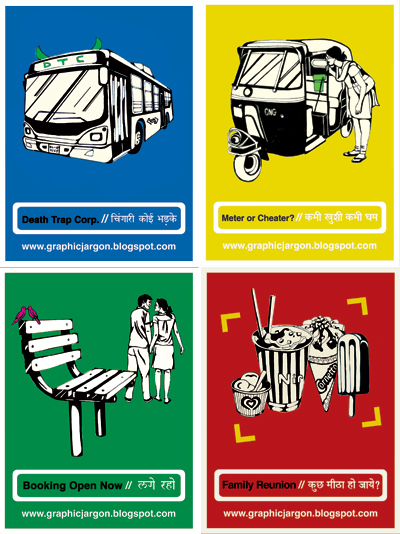
Worried about how visual culture like Helvetica has become a “universal typeface” that is homogenising our environment, graphic designer Sanchita Jain decided to wage war against globalisation. For her final-year Masters project at the LASALLE College of Art, Sanchita embarked on Decoding Culture, a project that is a “reaction to that homogenity” caused by the easy spread of ideas globally that were replacing unique places and cultures with one that looked the same no matter how far apart they were physically.

The ammo for her battle was a series of signs that she designed that highlighted unique aspects of her hometown in Delhi. Sanchita then put up these signs in Delhi to catch the attention of those living in the city and hopefully, igniting a discussion. The aim: to bring Delhi’s culture out to the open in order to remind those living in it about how unique it was. “My project brings people back to the tangible environment and uses cultural idiosynracies as an inside joke,” says the 24-year-old. “For example, there are two Singaporeans, and you both know Singlish, then Singlish is what unites you. You won’t talk about it much or say it out loud, but it is like a knowledge that unites a culture.”


fee_Delhi_04

Some of her signboards did attract much attention. Meter or Cheater? for instance refers to Delhi’s popular form of public transport auto rickshaws that are infamous for overcharging as they don’t use their meters. “I almost got mobbed,” she said. Though the auto drivers weren’t very happy with the sign, she feels that it has become a unique aspect of Delhi. Some of her signs — Fee to Pee refers to the practice of urinating in public and Death Trap Corp refers to the how dangerous it is to take Delhi buses — do showcase the negative aspects of her city, but they are also what makes it unique.

But there were signs that hardly got a reaction, and this Sanchita says, shows how these aspects of Delhi culture were lost to globalisation. Family Reunion depicts the practice of families going out at night to eat ice cream from street hawkers. Today, these families head straight to global chains like Baskin Robbins instead.

The signs themselves are also reminders of a dying Delhi culture. They are based on public signs in Delhi and were all hand-painted by Delhi signmakers like in the past. Today, these signs are printed by machines instead.
lego_Sing_02

As part of the project, Sanchita also created a series of signs for Singapore. These were based on discussions with her Singaporean friends about what was unique about this city. Unlike the colourful signs of Delhi, the Singapore ones look plain with just a hint of colour. This was a visual look she noticed in a lot of the advertisements found in our local newspapers. As it turned out, they must have looked right to Singaporeans. After putting up postcards of these Singapore signs at the LASALLE Show, they were all taken up in just 15 minutes!