Tag: Singapore Design

Fifty Years of Singapore Design Timeline

fifty-years-of-sg-design

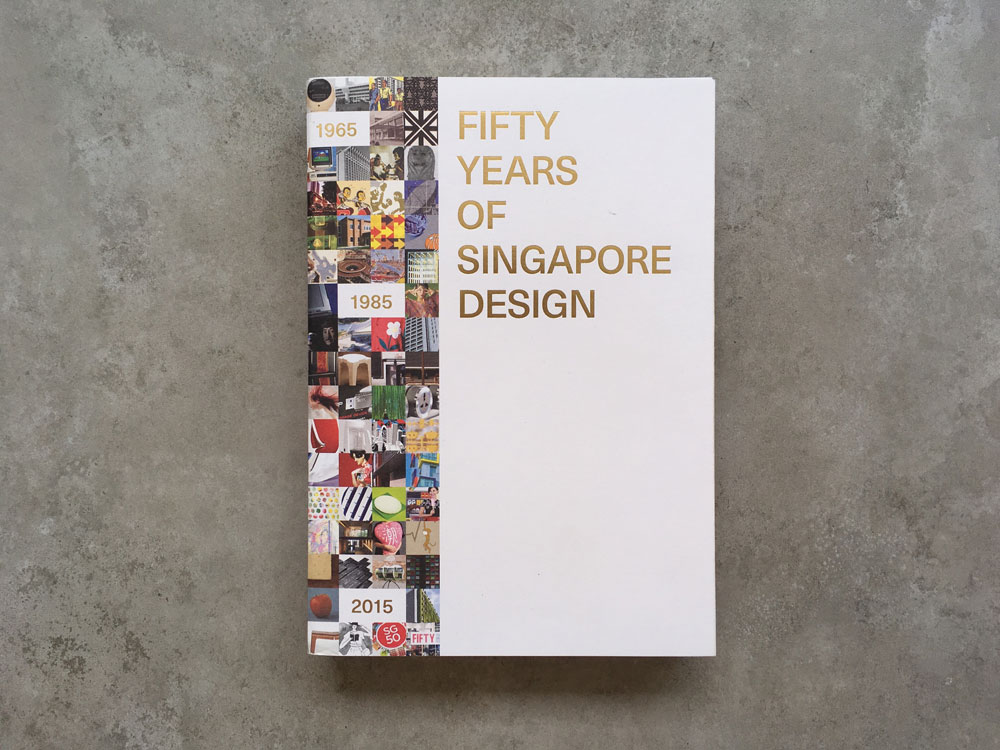
Coming after Singapore’s golden jubilee celebrations in 2015 is this Fifty Years of Singapore Design book that I got to work on for the DesignSingapore Council. For four months, beginning late last year, the team—including Dawn Lim and Sheere Ng—worked on turning the 2015 exhibition of the same name curated by WY-TO into this 333-page book.

Working with the existing selection of designs that were “iconic, popular and pivotal” to Singapore’s national history, we researched and wrote about the growth of the local design industry from independence in 1965 to 2015. Each decade has its own historical overview and selection of objects that are organised behind certain thematic developments that emerged during the period.
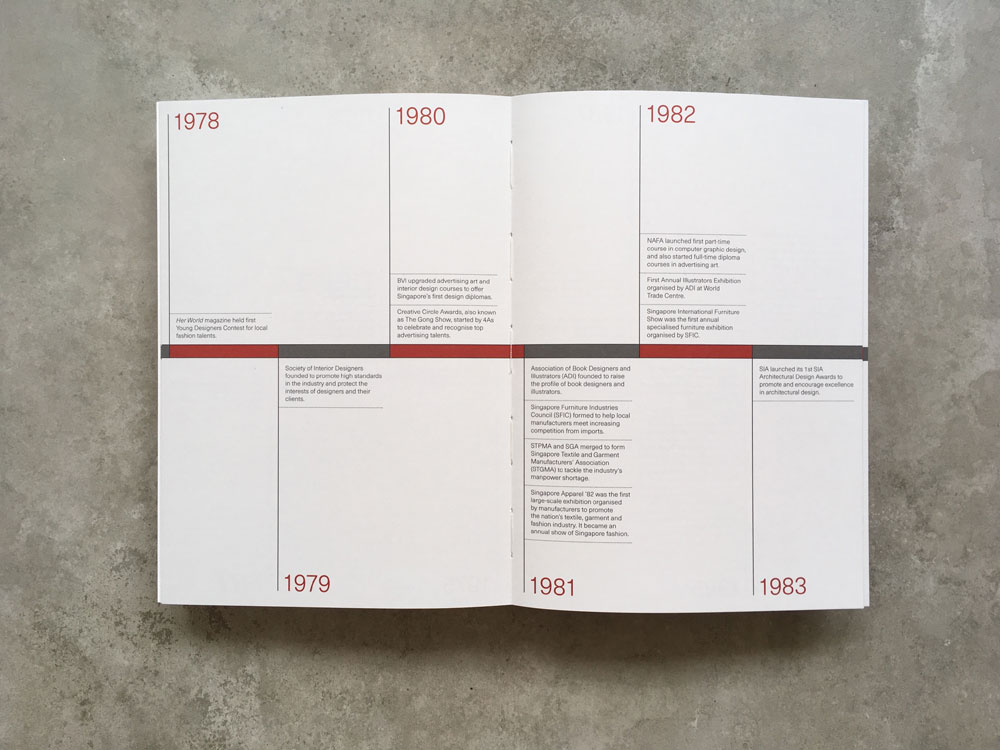
fifty-years-of-sg-design-timeline

Of particular interest to those keen on Singapore’s design history is a timeline that actually traces back to 1932, when a seed of industrial design was sown with the formation of the Singapore Manufacturers’ Association (today known as the Singapore Manufacturing Federation). While the original timeline simply listed milestones in the development of architecture and design in Singapore—focusing on government design policies, design education and the founding of various design associations—we sought to elaborate on each to provide a bit more context. The timeline is a skeleton waiting to be fleshed out, and hopefully, more Singapore design histories will emerge from this.

From my understanding, this book is not for sale but will eventually be made available in Singapore design schools and the public libraries. More information can be found in this press release put out by the DesignSingapore Council.
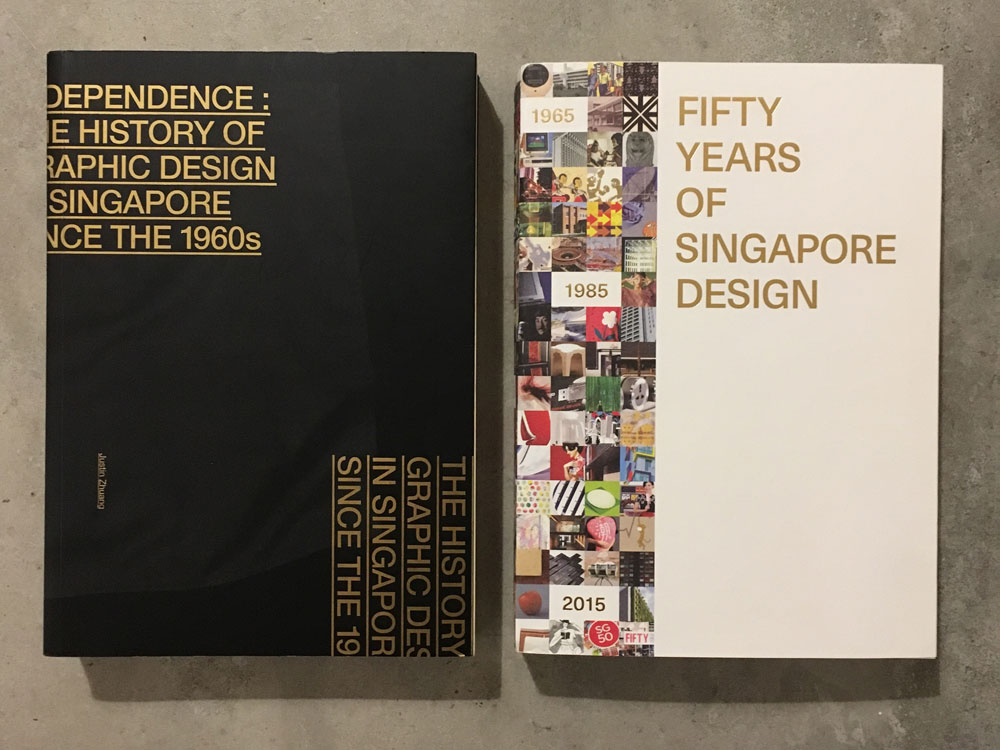
fiftyindependence

This book follows a 2012 publication I wrote on the history of graphic design in Singapore. While Fifty Years of Singapore Design was commissioned by a government agency, Independence: The History of Graphic Design in Singapore Since the 1960s was a ground-up initiative by The Design Society. Both books are designed by H55 Studio. For me, the books nicely bookend a period when Singaporeans’ initial curiosity for identity turned into a nationalistic hunger for nostalgia, as witnessed by the many projects put out for the SG50 campaign to commemorate Singapore’s 50th anniversary.

As a designer who came up to me at the launch said, “Thank you for remembering me.”

Championing for a Singapore creative industry: The Creative Circle’s Annual Advertising Award


GRAPHIC.SG

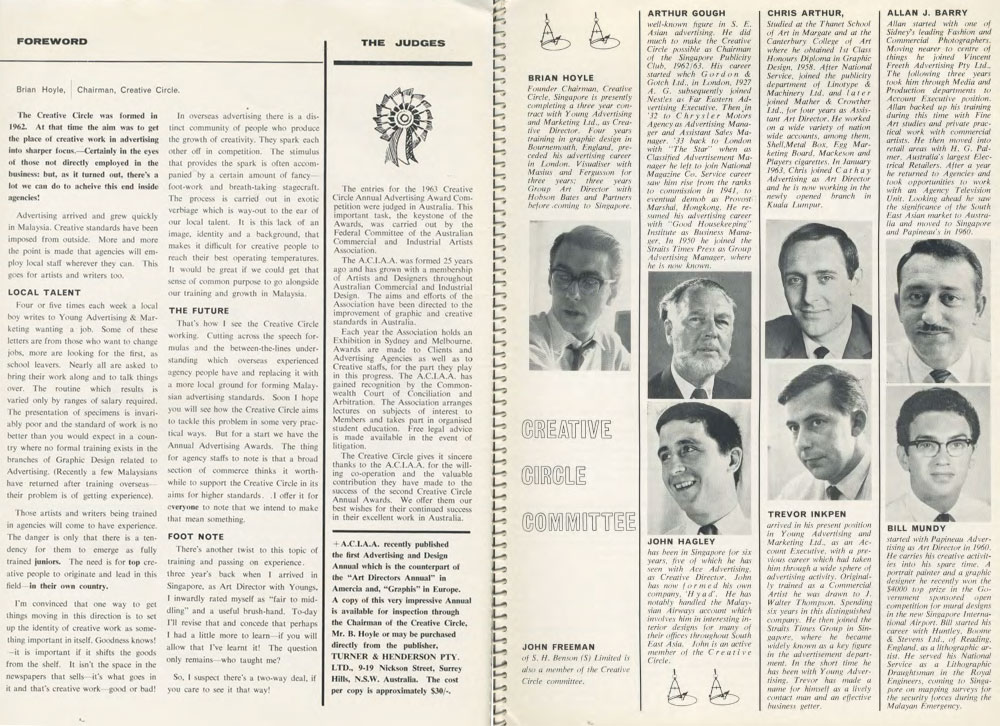
“The presentation of specimens is invariably poor and the standard of work is no better than you would expect in a country where no formal training exists in the branches of Graphic Design related to Advertising,” wrote Brian Hoyle in the 1963 Annual Advertising Award. This was what led the creative director of Young Advertising and Marketing Ltd to establish this awards—one of Singapore’s earliest prize for creative work in advertising—together with a committee of expatriates from the city’s various advertising agencies. Known as the Creative Circle Singapore, this group of the Singapore Publicity Club, was founded in 1962 to “stimulate an awareness of and a keener appreciation of visual creative standards in advertising”, largely through the awards.

The inaugural award received over 100 advertisements of “local creative origin” used during 1962  to see which were the best colour advertisement, black and white advertisement, photograph, publicity, radio commercial, and cinema advertising. There was also an overall winner. This “favourable response” led to an expansion of categories the following year, adding on best packaging, calendars, posters, brochures (including direct mail) and leaflets. All the entries for this second edition of the awards were judged in Australia by the Federal Committee of the Australian Commercial and Industrial Arts Association (ACCIAA). Of the 12 categories available in 1963, the Singapore and Malaysia branches of UK-based S.H. Benson International (which later became part of Ogilvy & Mather) swept up most of the awards with Hoyle’s Young Advertising & Marketing Ltd (renamed in 1966 as London Press Exchange (LPE) Singapore) coming in runner-up.

1963—Annual-Advertising-Award-Calendars-and-Posters

All the entries for the 1963 award were captured in the black and white annual printed by Cheong Press. Inside are also valuable profiles on members of the creative industry then and also essays on the standards of creative advertising and copywriting in Singapore and Malaysia. Contrary to the popular notion in these regions that “white men” came here to unfairly dominate the advertising industry, there were written pleas in the annual for locals to eventually captain their own industry. As Hoyle noted in his foreword. “The need is for top creative people to originate and lead in this field—in their own country.” (Bold emphasis are his). This was of course not entirely selfless. In another essay, Allan J. Barry from another agency Papineau Advertising, noted that “advertisements prepared for other markets are being used in Malaysia” but the country was a unique market that needed its own approach to selling.

“If you are prepared to accept this proposition you must also be prepared to accept the corollary that the people best suited to created the most effective approach for this market are the creative staff of local advertising agencies.”

1963—Annual-Advertising-Award-Foreword-and-Committee

In the course of my research for my book, Independence: The history of graphic design in Singapore since the 1960s, Brian Hoyle was kind enough to send over a copy of this historic annual advertising award. Thanks to designer Bernard Tan, a scanned copy of the annual is now freely available for download for research purposes. Do note that it is missing some blank pages and also one on the full list of winners.

References

Design50: A Nation’s Stunning Debut (1970s)

CREDIT: Singapore Sports Council Collection, courtesy of National Archives of Singapore and Sport Singapore

It was a breakthrough project for both designer and client.

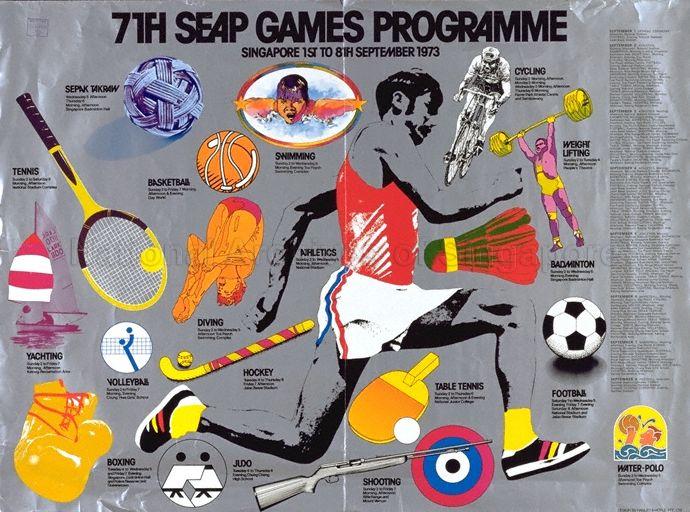
The 1973 Southeast Asian Peninsular (SEAP) Games was the first time the young nation of Singapore held a major international sporting event. It also led to this ground-breaking poster by local design consultancy Hagley & Hoyle.

Splashed across a silver background were a boxing glove, a Sepak takraw ball, a weightlifter, and other elements from the 18 sports played at the games. This universe of beautiful illustrations and photo-imagery gravitated around an athlete in mid-stride to make a stunning introduction to this competition that featured over 1,600 athletes from Thailand, Malaysia, South Vietnam, Laos, Burma (now Myanmar), the Khmer Republic, and Singapore.

Mr Brian Hoyle first moved to Singapore in 1960 to pursue an advertising career before starting one of Singapore’s early graphic design consultancy.

“It was quite a departure from what was acceptable at that point,” says then creative director Brian Hoyle. He had worked with his late art director Wong Mun Kin to conceptualise this 77-by-122 centimetres poster that listed out the week-long programme for the seventh edition of the games.

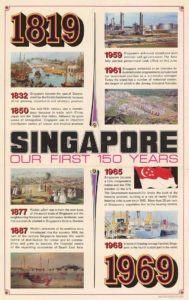
As the British expatriate recalls, design in Singapore was then thought of as just having images and text orderly lined up and “squared up in boxes”. Only a few years before, his studio had worked on a poster commemorating 150 years since the British founded modern Singapore which neatly listed out everything in two columns.

This 1973 SEAP Games poster, however, broke out of the box with its bold use of colour and imagery. It was a design that even Mr Hoyle thought was too “far out” for his clients, Mr Roy Daniels and Mr Alex Josey then working for the Ministry of Culture and National Sports Promotion Board respectively.

“The clients recognised what they thought was a good idea and a good style of presentation. I was quite pleased about it,” says the 80-year-old who is now retired in the UK.

Convincing the client was only half the battle won. In the days before computers were used in design, creating this complex design meant the use of many manual processes. Designer Peggy Tan, who had just joined the studio that year, explains how the illustrated photographs would have be converted into line prints before being stuck down piece by piece and the copy had to be pieced together separately by a typesetter before the poster was ready to be printed.

CREDIT: Ministry of Information, Communications and the Arts Collection, courtesy of National Archives of Singapore
A 1969 poster commemorating 150 years since the British founded modern Singapore

CREDIT: Ministry of Information, Communications and the Arts Collection, courtesy of National Archives of Singapore

“As a montage it was quite bold. It generated buzz simple because the images were created through different methods,” said Miss Tan who took over the business from Mr Hoyle and continues to run it today.

This unconventional poster was eventually put up in schools, offices and even housing estates all across Singapore. Despite the significance of the event, Mr Hoyle says it was simply another job for his then four-year old studio to prove the effectiveness of good design to clients in Singapore. In 1969, Mr Hoyle and fellow British expatriate John Hagley had set up their pioneering graphic design consultancy in an industry dominated by advertising agencies. While agencies profited from booking advertising space in media outlets, the duo wanted to make a living from offering design solutions instead. Hagley & Hoyle was part of a handful of early studios who helped the graphic design industry take root in Singapore.

The successful hosting of the 1973 SEAP Games also led Singapore to host subsequent editions of the competition now know as the Southeast Asian (SEA) Games—most recently, the 2015 edition. Along with the games also came the National Stadium and the formation of the Singapore Sports Council, both of which laid the foundation for today’s Sports Hub, Sport Singapore and the country’s aspirations to become a sporting nation.