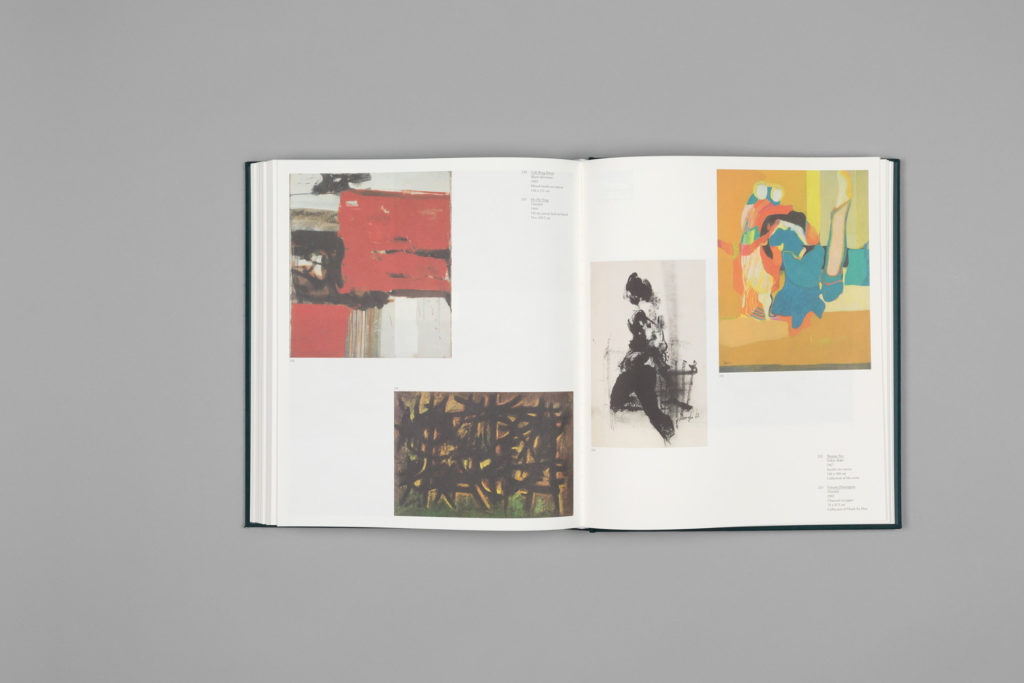
Much attention has been given to The National Gallery’s architecture and collection, but less so are the equally beautiful exhibition catalogues and publications coming out from Singapore’s latest arts destination. While printed books may seem archaic in today’s digital world, they remain the best medium—for now—to allow visitors to take home the vivid artworks they encounter during their visits to the museum.
This was struck me after encountering Somewhere Else’s design for Seeing the Kites Again, a publication showcasing the expressive calligraphic strokes of artist Wu Guanzhong. The different paper types, the custom typography, and considered layout all come together to produce a handsome publication worthy of this artist.
The studio led by Yong has also produced an equally evocative pair of books for Wu’s Beauty Beyond Form and artist Chua Ek Kay’s After the Rain.
PHOTO: SOMEWHERE ELSE
Holding up the National Gallery’s two inaugural exhibitions on Singapore and Southeast Asian art respectively, both covering the 19th century to present, is a modern frame designed by H55 Studio. In creative director Hanson Ho’s typical restrained and minimal approach, Siapa Nama Kamu? Art in Singapore since the 19th century(Malay for “What is your name?”) is reduced to a single line to be filled in, while Between Declarations and Dreams: Art of Southeast Asia since the 19th centuryhas its title visualised with Indonesian poet Chairil Anwar’s statement on the gap between the desire for national independence and its achievement in political terms debossed onto the cover.
PHOTO: H55 Studio
PHOTO: H55 Studio
PHOTO: H55 Studio
PHOTO: H55 Studio
Besides the catalogues, the National Gallery has also made an effort to produce research titles and children’s publications. The former is best represented by a collection of essays on arts and culture by pioneering Nanyang artist Liu Kang, elegantly packaged by The Press Room in a gold, black and white reader.
PHOTO: THE PRESS ROOM
PHOTO: THE PRESS ROOM
Of the many titles that have given Singapore illustrators the chance to introduce art to children, Warm Nights, Deathless Days,Sonny Liew’s take on artist Georgette Chen that comes in a thoughtful design of ampulets is a standout.
Comics and annual reports may sit on opposites ends of the bookshelf, but something kind of wonderful happened when design studio Couple combined them to create George Goes to Japan, a 111-page graphic novel recounting the work of Singapore philanthropy organization Lien Foundation. The medium seemed unconventional to the studio, led by Zann Wan and Kelvin Lok—all the more appropriate for a foundation that believes in “radical philanthropy,” as a method of tackling problems on eldercare, early childhood and water sanitation with “audacious creativity” for social good.
The new China Cultural Centre on Queen Street | THE STRAITS TIMES
Clad in grey and white tiles, arising 11-storeys above the ground, the China Cultural Centre towers over Queen Street in Singapore. Like a fortress, the boxy development thrusts itself out between an eccentric-looking hotel and the generic blue-and-white striped public housing podium block, maximising every inch of its sovereignty as the bulwark of Chinese culture in a foreign land. Established by the People’s Republic of China to promote and facilitate cultural exchange with Singapore, this centre is part of a network the rising superpower has established around the world as part of its global charm offence.
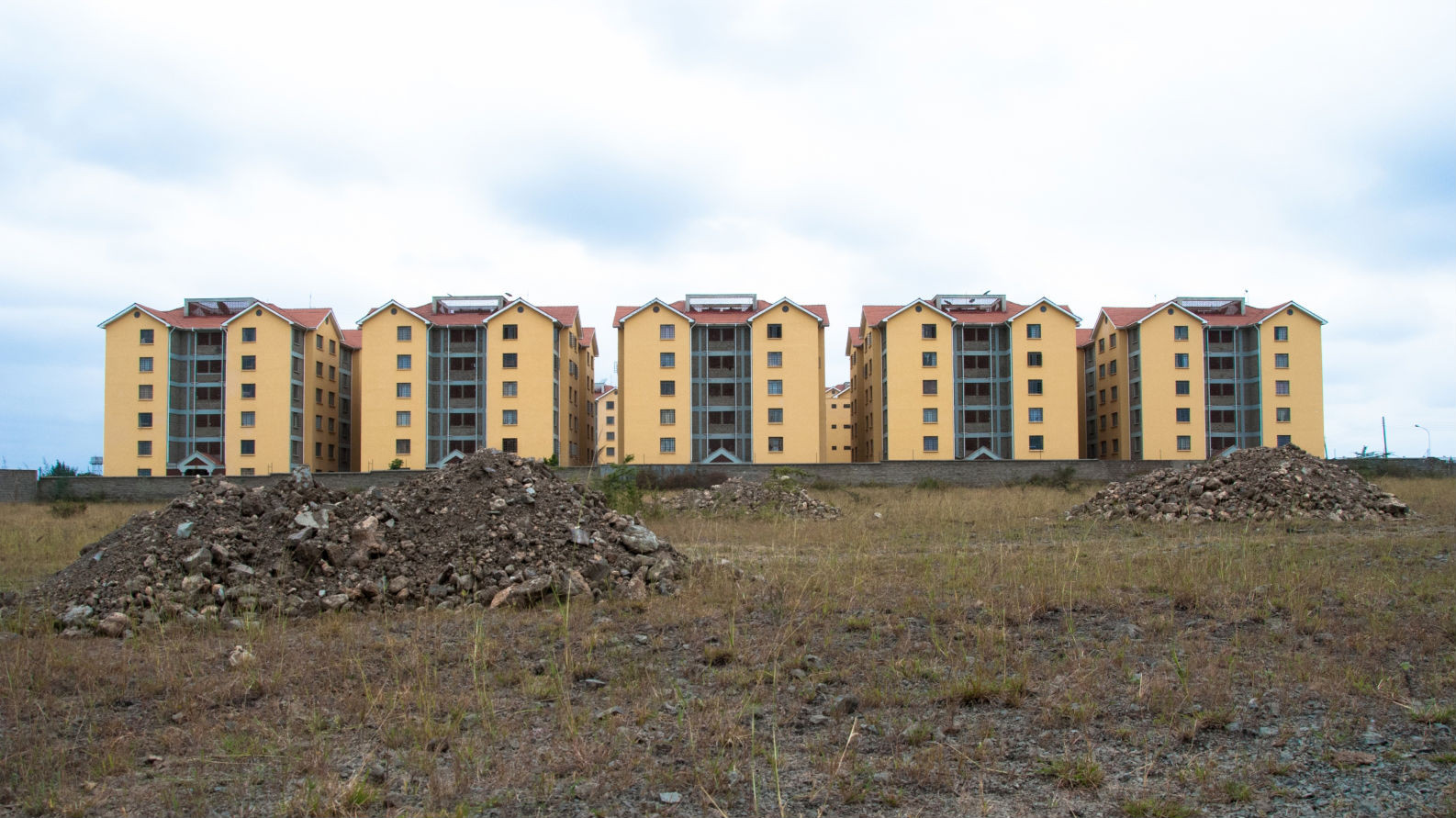
The Great Wall Apartments, a Chinese style residential compound in Nairobi, Kenya. | GO WEST PROJECT
If China-backed infrastructure is changing the face of cities in developing regions such as Africa, then cultural acupuncture is its other weapon of choice, particularly for developed cities such as Paris, Seoul and Berlin. The China Cultural Centre in Singapore, which officially opened last year to mark 25 years of diplomatic relations with the host country, offers an alternative to existing “Chinese” developments in a city that is pre-dominantly Chinese. While existing Singapore-developed spaces like the Chinese Garden (1975), Chinatown Historic District (conserved in 1989), the Sun Yat Sen Nanyang Memorial Hall (1994) and the Chinese Heritage Centre (1995) have used the narrative of the “overseas Chinese” to shape the identity of the Singaporean Chinese, the China Cultural Centre and the Confucius Institute in one-north offers a contemporary face to who the Chinese are today.
Liu Thai Ker | RSP ARCHITECTS
The new cultural centre is also a concrete manifestation of how China is increasingly linked to Singapore as its “urban solutions” provider. The Singapore centre marks the first time it is designed by a citizen from the host country: Liu Thai Ker. Lauded as the architect of modern Singapore, the former chief of the city’s public housing, and later, urban planning, has built up close ties with the Chinese since he briefed its late premier Deng Xiao Peng on the urbanisation of Singapore over three decades ago. Since then, Liu has been the go-to for advisor for several Chinese cities including being invited to chair the jury for the master plan of the 2008 Beijing Olympics Park.
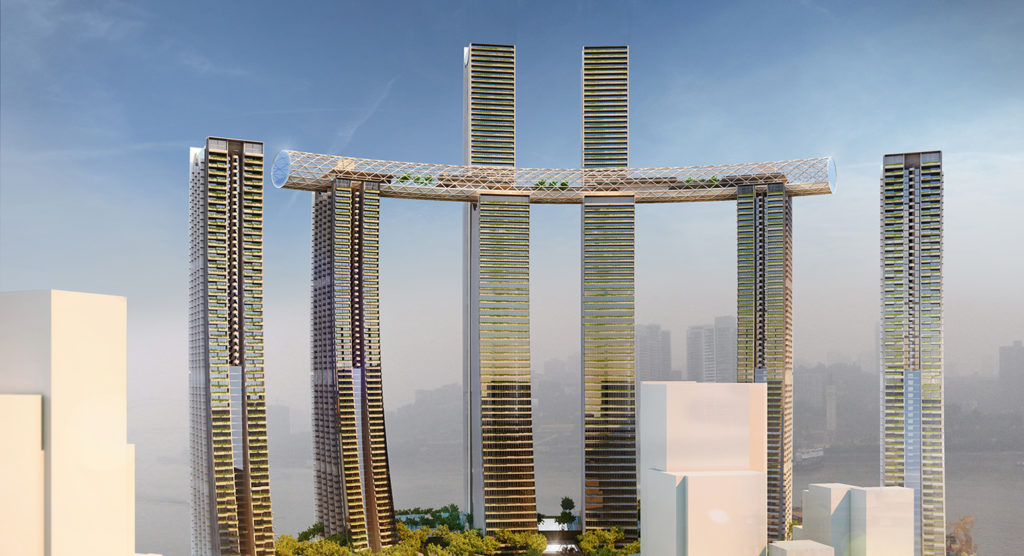
What Raffles City Chongqing will look like when ready in 2018. | CAPITALAND
This growing development raises intriguing questions. Will China come to resemble an upsized version of Singapore in the coming decades? There are already a proliferation of shopping malls by Singapore developer CapitaLand, including an upcoming Raffles City Chongqing in which starchitect Moshe Safdie seems to have designed a larger version of his iconic Marina Bay Sands for Singapore. Conversely, how will Singapore be shaped from its close urban relationship with China? The China Cultural Centre could be a harbinger of how Singapore develops as more of its architects operate in the megacities of China: where this colossal foreign relations centre now stands was once a two-storey community centre that fit much more snugly into the neighbourhood.




 Comics and annual reports may sit on opposites ends of the bookshelf, but something kind of wonderful happened when design studio