Tag: Singapore Design

The Model Behind this Artist

It may have become a popular art and design blog for many, but founder Yanda says his Singapore-based THEARTISTANDHISMODEL remains a personal diary that has helped the self-taught designer learn more his craft for close to a decade.
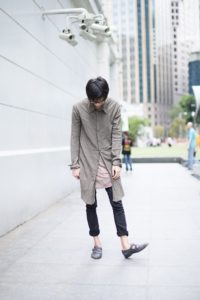
Designer Yanda trained his eye for design by starting a blog to catalogue creative work from around the world in 2005. | SHENTONISTA

“I started my blog nine years ago with a course mate in Ngee Ann Polytechnic where we were both studying Multimedia Computing . We wanted to learn about art and design, but couldn’t afford art or design books, so we started an online gallery to force ourselves to read these books and blogs about fashion, art and street wear.

Back then, I flipped a lot of books at the library and bookstores such as Kinokuniya and Basheer Graphic Books. If I found a work I like — from masters such as Picasso to fashion designers like Jun Takahashi — I’ll take down their name and go online to do more research. Initially, I wrote my opinions about the works, but it became a hassle, so now I cut and paste information instead.

I wanted to learn more about art and design after an internship interview. At that point, I didn’t know what I wanted to do with my life. I had emailed a few studios without a portfolio and Manic Design was kind enough to ask me in. Obviously, I did not get it because I had nothing to show. After I left, I felt like a failure, but I wanted the experience of working in a creative agency so much. I told myself I needed to learn more about art and design, so I started the website.

The name, ‘THEARTISTANDHISMODEL,’ points to the fact that behind every artist is some model — be it subject matter, business model, mentor, or someone you really want to impress. It wasn’t meant to be a serious website, but I wanted to learn more so I kept blogging even after my partner left when he became busy with National Service.

I’ve learnt how to design by looking and commenting and critiquing via my blog. When I see something nice, I will find out what is nice about the work and what are the thought processes behind it. I will go deep down into the construction and materials of things I like. I learn a lot about design through this process, and I also find out more about myself from what I like. I can’t rationalize what I like — probably things that have more ideas and are more visual.

There wasn’t any clear transition from blogging to starting my design studio DONOTDESIGN, but the blog has helped me become a curator, giving me an eye to pick out stuff for exhibitions and for the Showcase section in The Design Society Journal.

While the website has become very popular today, I wasn’t assured that my blog was nice or good until a few people pointed it out — even Theseus Chan of WORK commented that I now had an authority to comment on what was nice or not. When I visited studios in London last year, many of them also said that I had good posts.

But I don’t care about all this. I still blog the same way. Up till today, I only blog about the things I like. I don’t blog for other people, I blog for myself. It’s become such a huge personal diary that it is my online archive whenever I need to reference something for my own designs.”
From now till then

What will Singapore look like in 2030? That is the question in the minds of many Singaporeans nowadays. The government made the nation sit up and reflect on its future when it released reports in January 2013 on how the city-state could possibly change in the next decade and a half: not only would there be more people, land use would also be more intensive.

For many, it was shocking to envision such a city. How could Singapore take anymore development when signs of aging are starting to show just two years before it turns 50 in 2015?

Over the last few years, its highly reliable infrastructure broke down several times, leading to flooded streets and disrupted train services. Last year, it witnessed its first industrial strike in decades, led by bus drivers recruited from China, who have become a common sight in a city increasingly reliant on migrant workers. The once squeaky clean government has also come under scrutiny with several of its honchos facing corruption accusations. Most recently, a Member of Parliament from the ruling People’s Action Party (PAP) resigned over an extra-marital affair. This triggered a by-election which saw the opposition party gain yet another seat in the government. While the PAP was the only party in power since independence for over two decades, there are now 7 elected from the opposition Workers’ Party — albeit a tiny fraction out of a total of 87 seats.

Such cases have led observers living in Singapore to go as far as to suggest that the city is living in a “new normal”. It may be premature, but it has certainly got Singaporeans thinking about possibilities. The government has even tried to harness this energy by recently initiating a “National Conversation”, promising to listen to what Singapore citizens wanted, so that it can shape its future policies.

As part of this new generation of Singaporeans who are in the 20s and 30s, I do hear murmurings from my peers who envision a different city from what we grew up in. While those before us may have emerged from the oft-told struggle in which Singapore went from Third World to First, we grew up in a city that became a global city in the ‘90s, renowned for its efficiency and roaring economic success. While we may have worshipped the Western world then and  were proud to have made English our language of choice,  the tides have changed two decades on. Singapore finds itself looking towards Asia for its future. We now find ourselves — grandchildren of immigrants from Asia — caught in-between our historical roots with the region and how comfortably assimilated we have become with the Western world.

The truth, perhaps, is we are rootless — disconnected from our ancestors with not much else in Singapore to latch on to either. It is perhaps why so many of my peers and I have started to mine our histories to find out who we are. Whether it is the love for all things retro or a kind of wide-eyed wonder towards anything from the past, we often seem trapped in a nostalgia for a past we never lived through, but yearn to have grown up in. Any news of the impending demolishing of an old place in Singapore becomes an opportunity for us to whip out cameras and video recorders to stake our ‘memory‘ of a city lost to the future.

This question of who we are and who is this city becomes even more pronounced as Singaporeans and Singapore become more cosmopolitan. Our insecurity and inability to say who we are shows in how xenophobic we are nowadays — a kind of refusal to reflect on who we are, but instead assert the claim that they are not us. 

In these uncertain times, I find comfort in seeing other Singaporeans getting their hands dirty to create change. This city guide is an attempt to map out some of these efforts, and help us navigate the possible Singapores that are emerging. From its people, places and phenomena, there are signs of what the future holds for this city.

Nguan’s Singapore sets the tone with his pictures that captures the mood of Singaporeans as they go about their everyday lives. Two interviews with The Thought Collective and studioKALEIDO give insights to the new values and ideas that are shaping the city’s future, while August 9 Portraits by Sam & Sam reflects the wishes its citizens have for the nation as recorded on its birthday last year.

A tour of spaces in Singapore captures how the city’s landscape is changing as well. In Wide Open Possibilities, experience up-and-coming neighbourhood Jalan Besar as mapped out by local independent travel guide alter:sg, while a fictional essay from the literary magazine Ceriph, shows an aspect of the city through the eyes of a young Singapore writer.

Finally, in Anew Singapore, we explore some of the ongoing trends in the city as well as its design, magazine, food, and music scenes that hint at the values that matter to young Singaporeans today what might define their tomorrows.

When one flips back at this guide in 2030, how much of Singapore will we recognise? The journey there starts now.

———–
Written in 2013 for The Alpine Review as part of a proposed city guide on Singapore. The section was never published. Thanks to Nguan, Dan Koh, Shin Lin, Rebecca Toh, Iliyas Ong, Samuel He, Sam Chin, Benjamin Koh, Winnie Wu, and Amanda Lee-Koe for their help on the guide.

1980s: Sowing the seeds of SG graphic design today

These messages of a graphic design educator to his graduates suggest how Singapore design has developed since the 1980s.

Working outside of advertising agencies, producing conceptually-driven work and packaging local products to sell overseas — these are what many Singapore graphic designers do today.

They are also what one Singapore graphic design lecturer urged his students to do some three decades ago at the Nanyang Academy of Fine Arts, one of only three design schools that existed in the city during this time.

Tan Ping Chiang (1984/85)
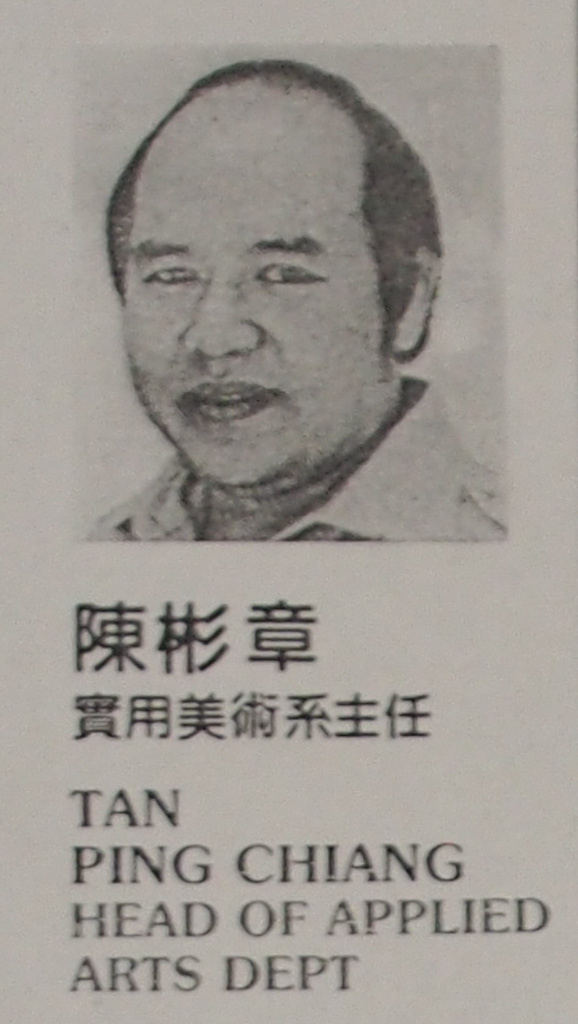
A photo of Tan in the 1984/85 annual.

As head of the academy’s applied arts department, Mr Tan Ping Chiang (陳彬章), penned messages in its graduation annuals that outlined the role of Singapore graphic designers in the ’80s. In the midst of Singapore’s second industrial revolution in 1980, the former NAFA fine arts graduate urged the academy’s students to look for work beyond the narrow confines of advertising as “agencies were not the only way out” (“廣告公司並非唯一的出路”). Like how he worked as an in-house designer for the government, graphic designers could apply their skills in other sectors of the economy, and mirror the nation’s shift then from labour-intensive industries to those that of high value-added and wages.

To the graduates of 1984, he further elaborated on how this economical shift was changing what employers and clients expected of designers. Summing it up as “We Pay For Your Idea”, the designer who had worked and obtained his diploma in graphic design in England for six years from 1966, stressed the importance of “ideas” and “creativity” and not just craft and skills for the contemporary designer.

Dress-Up-Our-Local-Food-Products
Tan’s message for graduates in the 1981 annual.
We-Pay-For-Your-Idea
In 1984, Tan outlined the importance of “creativity” and “ideas” in contemporary design.


Tan had a particular interest in food packaging, and once urged the academy’s graduates to “Dress up our local food products”. Design could help such products sell better in Singapore and overseas, although he cautioned against creating packaging that simply imitated either the west or Japan. Later in life, he wrote a thesis on the value of food packaging in Singapore for his Master of Design from the University of Western Sydney and also illustrated Singapore Delicious and Delirious, a visual tour of the city’s food culture.

This love for food and design has spread to his industrial designer son, Tan Lun Cheak. As one of the founders of design collective Little Thoughts Group, Lun Cheak has created several products that reflect Singapore’s food culture including a steamboat that is also a lamp, and a plate that aids the tossing and turning of the traditional Lunar New Year dish of Yusheng, an act which symbolises good luck and prosperity.

The elder Tan, who turns 73 this year, is now working on his art works and blogs regularly about his travels.