Tag: Singapore Design

National Museum of Singapore Logo

While working on a upcoming book on the history of graphic design in Singapore, I came across this really beautiful logo of the National Museum of Singapore on a poster for an event in 1993.

PIX: STEEL WOOL

Do you see the inspiration for the logo? I have no clue when the logo was designed and who did it. But since the museum underwent a massive renovations and re-opened in 2006, it has adopted this logo instead.

This definitely looks contemporary, and also allows the National Museum of Singapore to use it even if it moves out of its iconic building. But that’s also why I prefer the earlier logo — it visually situates the museum to an architecture that I recognise as Singapore!

“Danger: Keep Out!”—Remembering a Safer Singapore

Danger 1 (JZ)

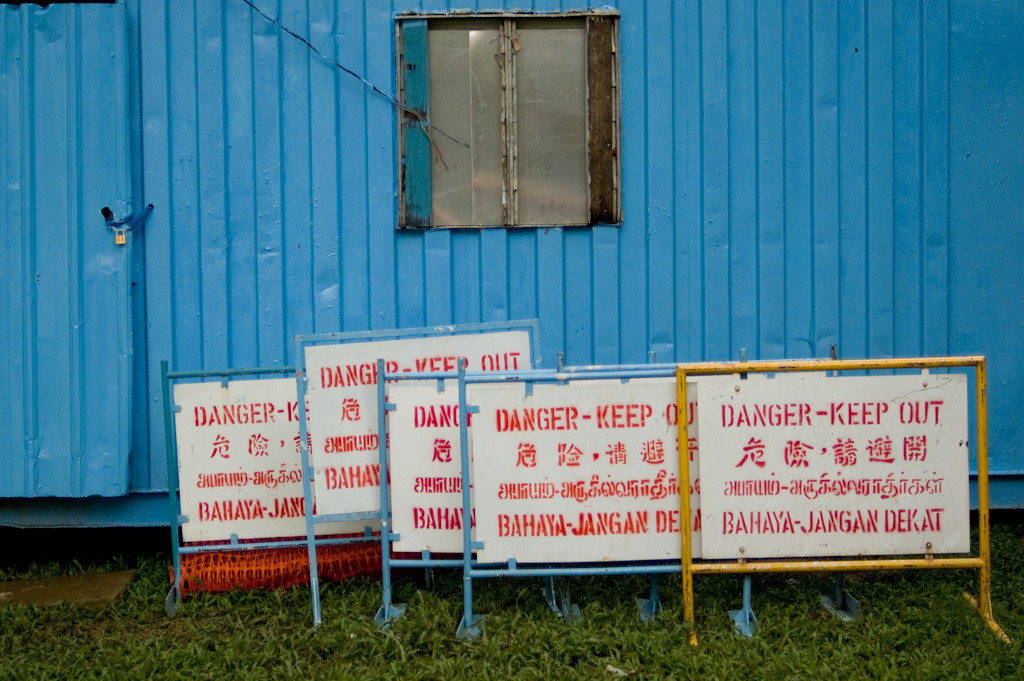
There’s red, there’s white, and it even comes in English, Chinese, Malay and Tamil. All this in a rectangular board about the size of a flag. The “Danger-Keep Out!” sign is how I remember my Singapore, a ‘flag’ representing the visual culture that surrounds us in this city.

You can find it all around in this city, which is perpetually in construction or undergoing some makeover. As long as something is being built, serviced, or torn down, this simply designed sign helps to keep Singaporeans safe by communicating to us that there’s dangerous work going on behind it, and we should keep our distance.

To make sure everyone in Singapore gets this message, it is repeated in the country’s four official languages. This equality extends to even how each line is spaced out so that they look equally long, regardless of language. And even if you don’t understand any of the languages, seeing four exclamation marks on a single board should surely tell you something is amiss.

This sign is functional and without frills, just text on a blank board in a single colour. But it isn’t just the design that reminds me of Singapore, how it is created bears the hallmarks of this city’s love for efficiency and its approach towards many things. The look of the letters suggest a pre-designed template is used to manually produce identical copies of this sign quickly without compromising quality.

Ironically, as Singapore continues to develop and re-construct itself, even this “Danger-Keep Out!” sign has not been spared. Nowadays, with technology, these signs are produced by digital printers that replace craftsmanship with machine precision. Sometimes, this is taken to its extremes, such as construction sites with ‘Danger-Keep Out’ signs printed in A4-size and kept in plastic sleeves!

Slowly, but surely, such signs are also being replaced. Instead of construction sites fenced with empty walls plastered with “Danger-Keep Out!”, carefully designed walls displaying what is being constructed are increasingly common. It’s a reflection of a more “designed” Singapore, but also how open we have become. We don’t just care about function and safety, but also spend a little more thought and money to be inviting and informative. Instead of keeping people out from a future that is being built because of the overriding concern for safety, the new signs promise and invite them to be a part of it, visually at least.

But what will happen to the “Danger-Keep Out” sign that I remember? Here’s an interesting take by Singapore graphic design studio Bravo Company. They re-appropriated this sign that they thought was being ignored by Singaporeans, who had become so used to seeing construction sites. After the General Elections in May, they used these warning signs to spread words of encouragement instead.

“I think the sign is an understated symbol of Singapore. We are the only country in the world that has the need to display all important messages in four different languages,” said its co-founder Edwin Tan.

How an everyday visual symbol, originally intended to be functional, becomes an icon, is an example of how inspiring our own heritage can be. It also shows how what we see around the city — all that is designed and built — can also become markers of memories. And that these collective memories are constantly re-interpreted and used in the present reminds us of how much we’ve constructed as a nation, and that this journey of remembering never ends, but only evolves with each generation.

———–
Written for Singapore Memory Project’s iremembersg.

Has media become nothing more than marketing?

“Media and publishing is now just another form of marketing for those who can afford it.

“And those who create good content? Get close to nothing — or nothing.”

So says my friend, Zakaria Zainal, an independent photojournalist.

It’s hard to disagree, going by what I’ve been seeing in the media market both in Singapore and the world. A couple of months ago, I wrote about how new publishers of media here today are not purely media companies anymore, but graphic design studios or companies that essentially do not earn from media at all.

Underscore, published by design studio Hjgher, is a classic case. At The Design Society’s Sessions last night on the phenomenon of self-publishing, I got to ask publisher Justin Long how the magazine earned its revenue. His answer? It barely breaks even. But Underscore is not about making money, he said. Instead, it earns its “value” through the network of friends it has gained, and how it has helped to market the studio to the world. According to Long, only a 1000 copies are sold in Singapore, and the rest, some 4000, are distributed overseas. The other two speakers that evening also had similar models. Basheer distributes and sells books, when it does publish books, it makes sure the market is big enough. Yanda, the man behind THEARTISTANDHISMODEL keeps his blog going purely out of passion, and also makes a living from elsewhere.

What surprised me the most was that none of the contributors to Underscore magazine get paid, according to Long. For someone who earns his keep from producing media, it only proves that I cannot earn from creating media I like. Instead, I have to “sponsor” work that I like by taking on jobs that actually pay — essentially Underscore‘s business model. Although I still continue contributing to magazines and websites that pay very little, because I believe in the magazine and the content that it puts out, you always question how sustainable is this. Will the contributor/magazine who doesn’t get paid or gets paid miserly eventually die out? Highly likely.

A conversation that happened after Sessions also proved Zakaria’s point. A designer told me about a client who wanted to create media online to attract eyeballs to his brand. It shows that people do demand good content, but at the same time, they are not willing to pay for it directly. So, businesses have benefitted the most from the boom in self-publishing. They can easily fund and create media that will eventually attract attention their brands. On the other hand, media not meant for marketing or commercial gains find it easy to start, but hard to sustain.

But this problem is nothing new, traditional media’s approach has been to sleep with advertisers. But now that readers are immune to the advertisement and content distinction, media owners are forced to blur the lines, producing advertorials to keep this age-old funding model alive. Look at Monocle and how it partners with governments and corporations to produce content, events and even products. While a Monocle x Porter bag shows how strong the media brand is, you also question, what difference does Monocle make to the Porter bag? It’s a fine line between meaningful collaborations and selling out.

So where does all this leave media producers like me? Are we cheapening ourselves by sleeping so readily with companies and organisations just for a platform to say our piece? Can we demand media owners pay bigger share, especially if they are profiting from it? Should consumers pay us more and directly?

I haven’t figured it out. But as Zakaria says: “Exciting times nonetheless.”