Tag: Singapore Design

VOTE FOR ME: Elections Posters in Singapore (1)

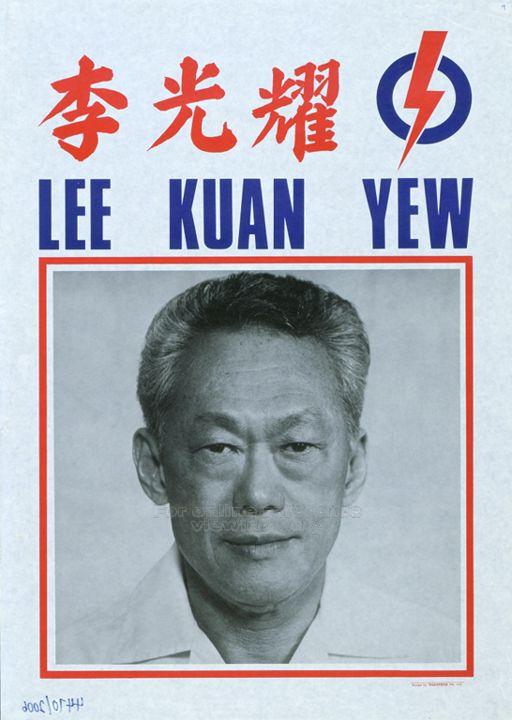
Here’s a sure sign that the general elections has begun: when elections posters start popping up all over your neighbourhood! Besides rallies and media reports, posters are the most visible form of an election campaign. These traditionally come in three forms, depicting the party’s logo, its manifesto, and the candidate contesting. This is a set from the People’s Action Party (PAP) General Elections campaign in 1980.

1980 PAP1980 PAP Compare 1980 PAP LKY

In the first of this two-part post, I’ll be looking at the manifesto posters of the parties since 1972. It starts from Singapore’s second post-independence election as it is the earliest poster I could find in the National Archive’s POSTERS Database, where I have got all the images from. In this 1972 poster of candidate Lim Kim San, the three elements of party logo, manifesto, and candidate are all rolled into one, but by the next election in 1976, posters came in three separate forms as depicted above.
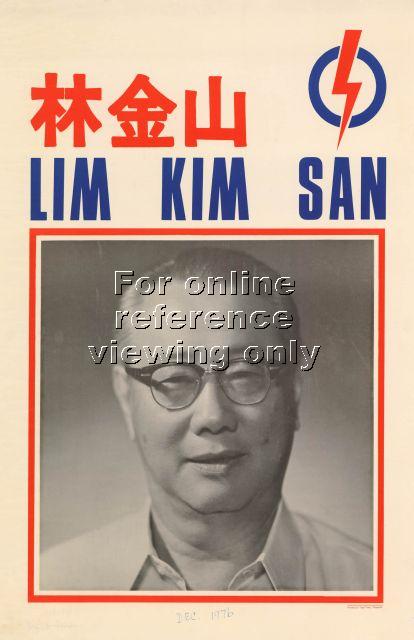
1976 PAP Lim Kim San

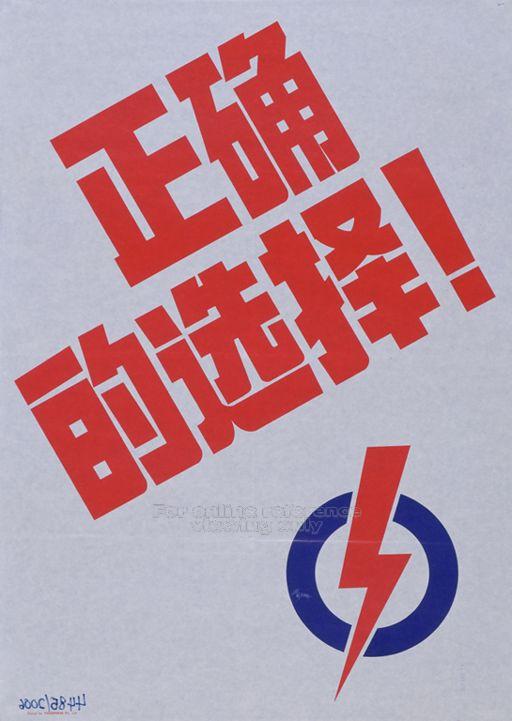
As with most visual culture for the public here, a unique element of election posters here is the use of Singapore’s four official languages. These are 1980 posters from PAP’s “The Right Choice” campaign.

Over the years, the PAP has used various visual forms to express its platform of material progress in its manifesto posters. The 1980 poster depicts its oft-used rhetoric of past versus progress, and so do the posters used in the next two elections of 1984 and 1988.

1980 PAP 1 1980 PAP 2 1980 PAP 3

In 1988, the PAP also took advantage of the official launch of Singapore’s MRT system that year to come up a smart campaign poster.
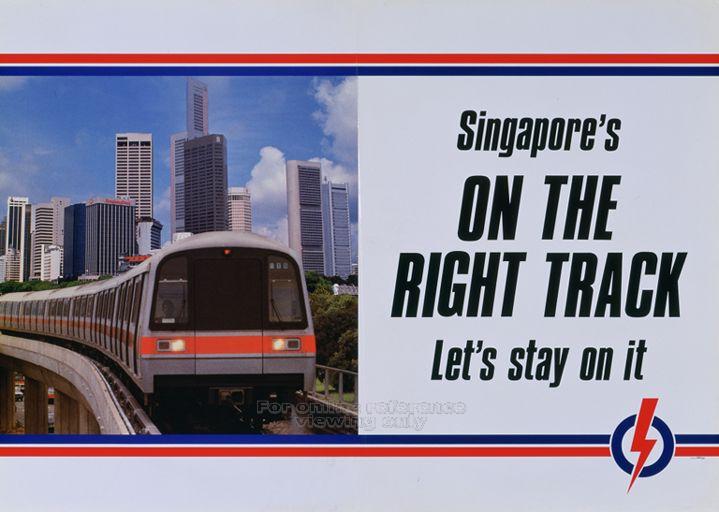
1988 PAP A1

The PAP’s election posters though the 1990s became more dull under the leadership of Goh Chok Tong.

1991 PAP 0


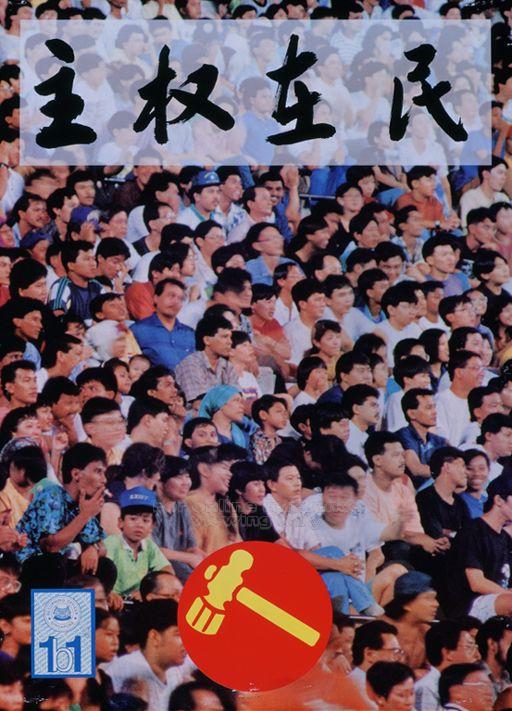
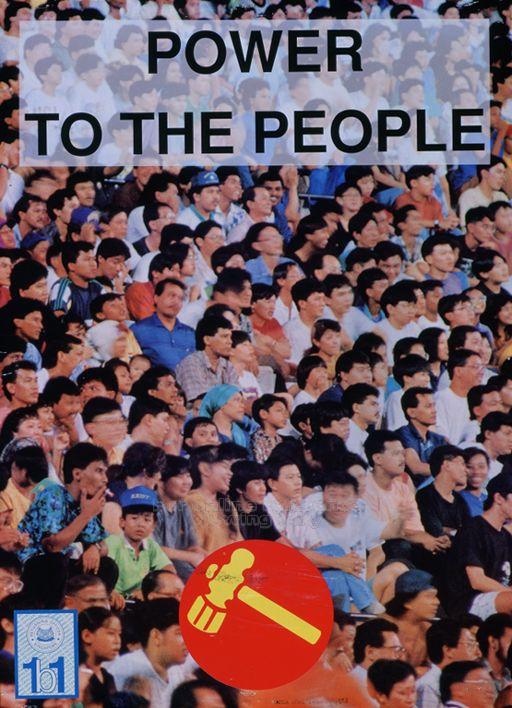
In contrast, posters of opposition party The Workers Party’s seemed to capture the voice of its leader J B Jeyaretnam, the first opposition candidate to break the PAP monopoly in the 1981 by-elections. WP’s slogan of “Power To The People”  was easily translated into a powerful visual rhetoric as first seen in this 1991 poster. However, the photo used seems to be a stock photo of people in a Western country.

1991 WP 1

For the next elections in 1997, WP improved on this poster. The Chinese version with its forceful calligraphy matches memories of WP candidate Tang Liang Hong’s controversial speeches that got him labelled by the PAP candidates as a ‘Chinese Chauvinist’. After the elections, he got sued for defamation and has since fled Singapore.
1997 WP A

1997 WP D

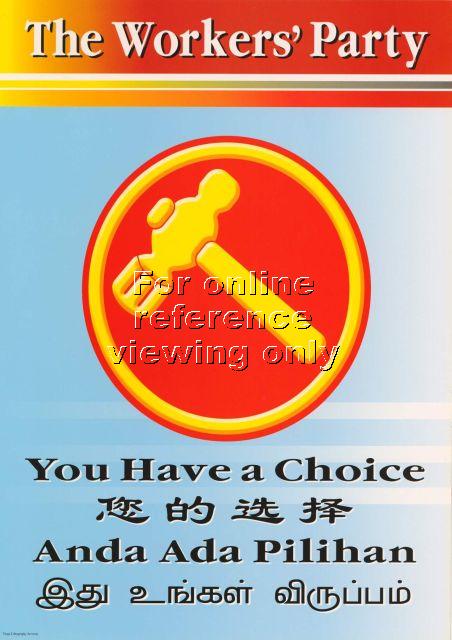
Despite these highly memorable posters, the WP was unable to convince the people to power it into power, garnering only one Parliamentary seat in both elections. Perhaps, this was why it toned down its visual rhetoric in the subsequent elections. Moreover, the rise of Low Thia Khiang to become leader of the WP and the ousting of the fiery J B Jeyaretnam also ushered in a quieter form of politics as seen in these 2001 and 2006 posters.
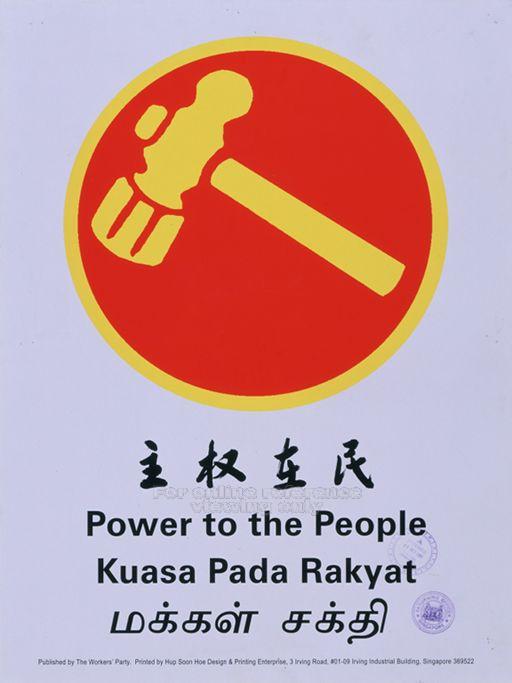
2001 WP A

2006 WP

The PAP has also adopted a more sophisticated visual language with its manifesto posters in the new millennium. One reason for this change seems to be the availability of technology such as Photoshop and cheap colour printing. As seen in the 2001 poster of Goh Chok Tong and the 2006 poster of current prime minister Lee Hsein Loong, these are clearly creations of the times, and they’ve been crafted to depict the PAP’s belief that the way to govern Singapore is through a strong leadership backed by the support of the people.

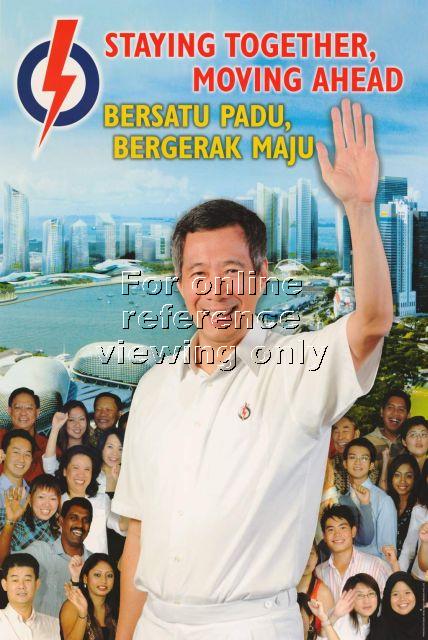
2001 PAP B

2006 PAP 0


In the next post, I’ll be looking at the posters depicting the party’s logo and their candidates, including some whacky ones from independent candidates!

?: Is Design Translation

A group of literature lovers have come together to start an online international journal dedicated to literary translation. Aptly-named after the mathematical term for two lines on a graph that tend towards each other but never reach, Asymptote, is a conceived-in-Singapore journal that will translate literary works from around the world into English to create encounters between languages. “The value of translation is that it unleashes from latency ideas and emotions to a vast sea of others who do not have access to the language in which these ideas and emotions reside,” writes the introduction on the website. Besides being able to read the translated works, one will also get to see the work in its original language, and may even get to hear a reading of the original work.

It’s encouraging that this project was conceived here in multicultural Singapore, where language is probably one of the most divisive cultural element of life here. The different racial communities have newspapers in their own languages and the government’s policy has been to turn to English as the ‘neutral’ language to speak to its people. It also got me thinking if design could be considered as a form of literary translation as well. After all, don’t designers have to create their visuals based on textual briefs? And isn’t a successful design one that can cross cultural boundaries?

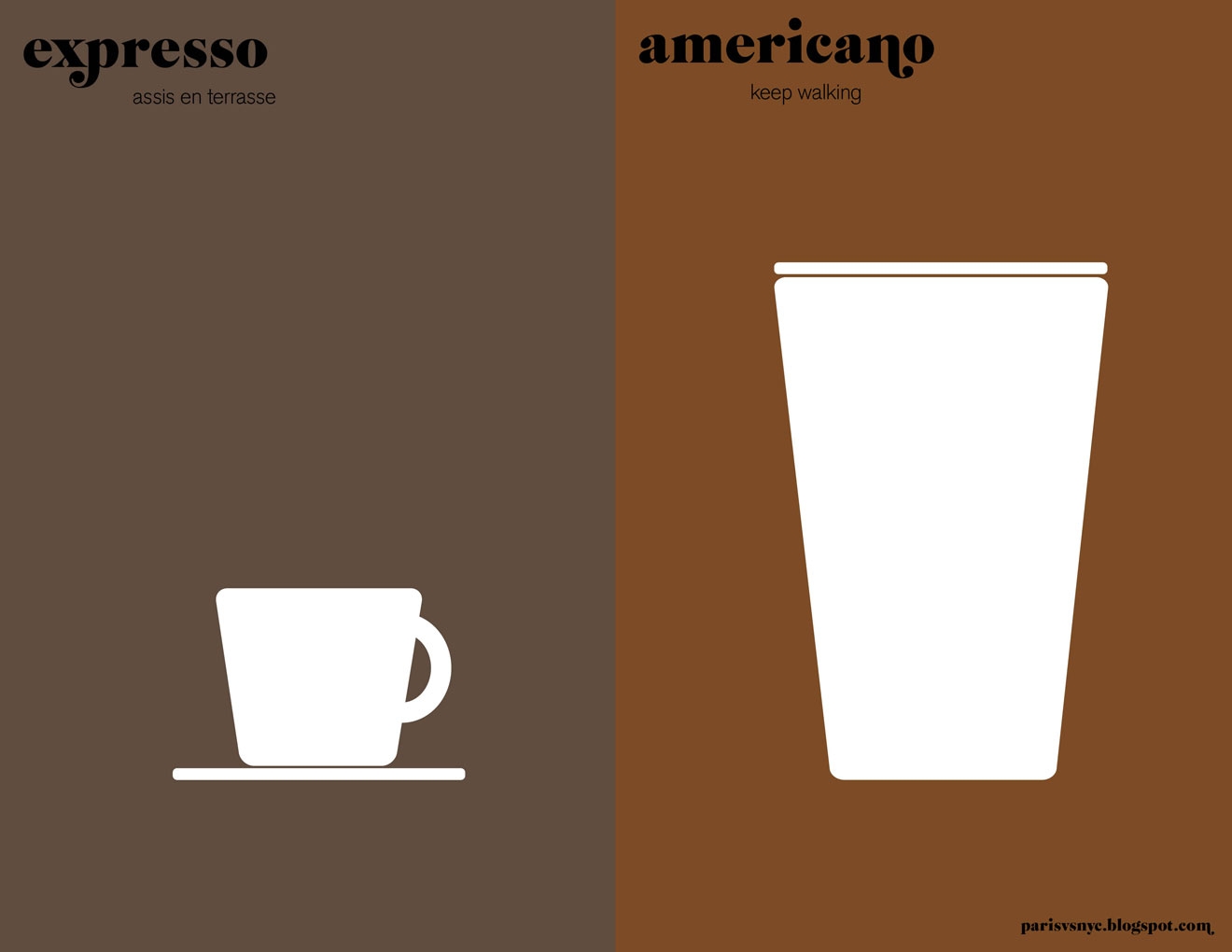
Like the literary community, I think design here is also divided by different (visual) languages that reflect its designers and the intended audience. But what if we put designs of similar messages side-by-side, can we also “unleash” new expressions? Here’s a piece from Vahram Muratyan’s on-going graphic design project comparing the cities of New York and Paris:

This visual translation of “coffee” may not be the best instance of different graphic languages, but it does express the different product designs.

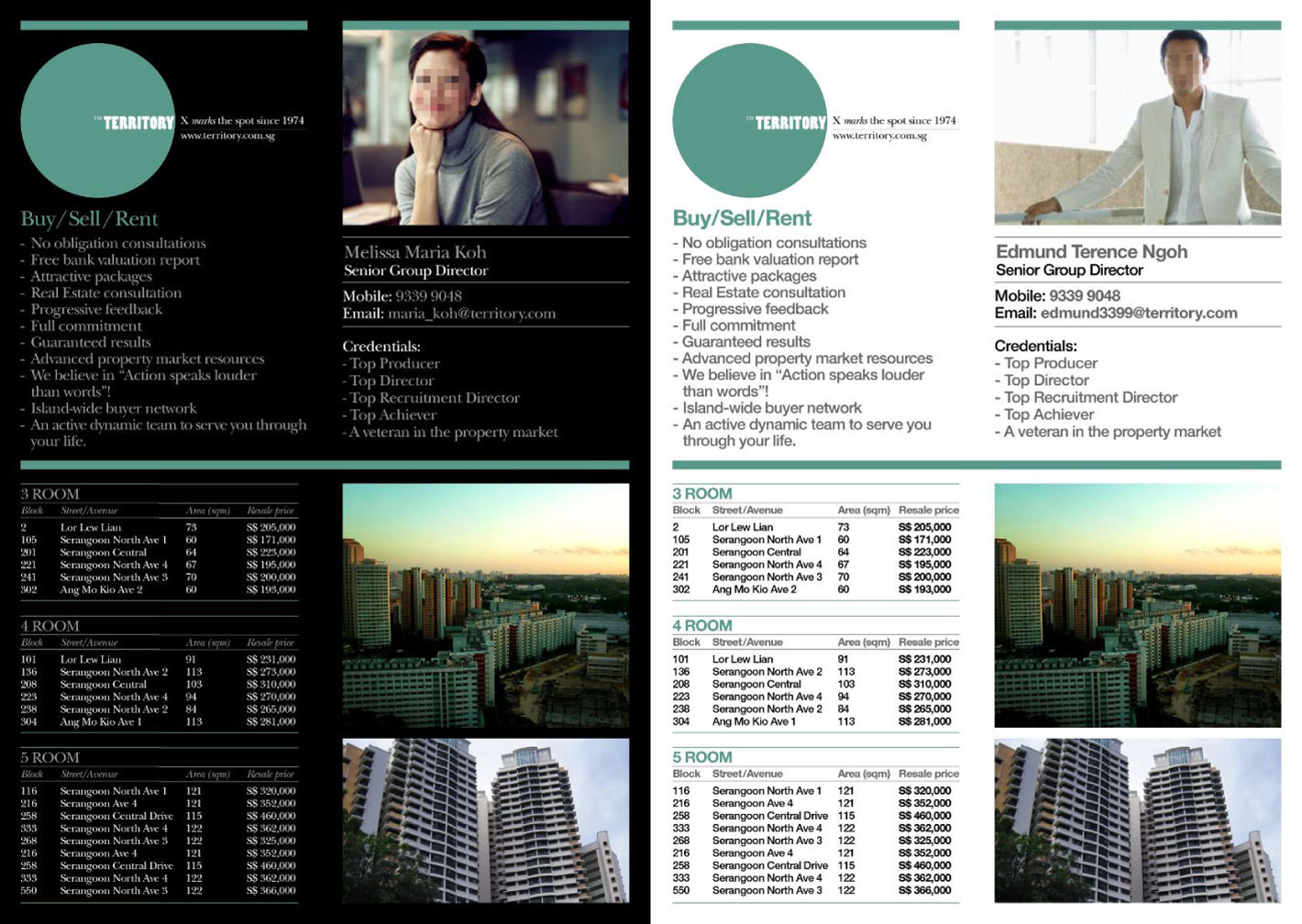
A good example of comparing visual languages may be found in Bloc Me, a local project by &Larry and Daniel Koh. Tired of the flyers from property agents here that they describe as “bloody eyesores”, the two designers have created templates for them to download and use instead.

sub_bloc_me_2


S’pore’s Third Attempt to Set-up a Design Centre

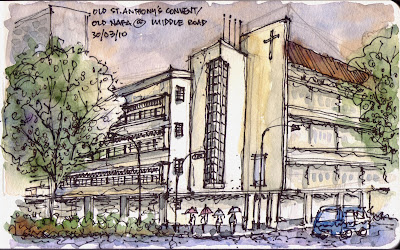
Singapore will soon have a National Design Centre at 111 Middle Road. Consisting of a Design Gallery, Design Shop, and a Design and Innovation Academy, it will provide a “one-stop centre for design”, helping to promote design to the industry and businesses, said Minister Lui Tuck Yew at the President’s Design Award Ceremony on Friday.

It is not the first attempt to give the design community here a home. Back in 1964, the Economic and Development Board started promoting design to manufacturers as a way to make Made-in-Singapore products more competitive and exportable. It started a Product and Design Centre in the then John Little Building to showcase good design products so as to show businesses the need to use design.

In 1967, the centre was handed to the Singapore Manufacturers’ Association (SMA) and renamed the Product Display Centre. When SMA moved out of the building in 1973, it set up a display centre for Made-in-Singapore products in its new offices at Colombo Court Building. A year later, the government’s design promotion efforts were transferred to the Singapore Institute of Standards and Research (SISIR) where it was to remain till it became the work of the Trade and Development Board (TDB) in 1985.

The end of the 1980s saw a period when the government aggressively promote design when it began organising the International Design Forum and gave businesses money to use design. In 1992, the TDB opened The Design Centre at North Bridge Road. Consisting of three levels, The Design Centre had TDB’s design promotion offices, a design shop, an exhibition space to showcase good design, and a library stocked full of design books.

Many design students then paid the small membership fee to use the library as it was the only source for design books other than browsing at Basheer Graphic Books and Page One. However, just three years after it opened, the centre closed down when TDB moved into its offices at Bugis Junction. Many of the books were transfered to the National Library Board, and if you flip through a design book in the library today, you may just find a chop on the page that says “The Design Centre”.

So will this new design centre be third time lucky? Will it outlast what seems like the government’s cyclical support of design in Singapore? I sure hope so.

PAULARTSG