What did a dot see on New York City’s streets?
———–
Produced for Adam Levy and Joshua Hume’s Video Essay class at D-Crit.
What did a dot see on New York City’s streets?
———–
Produced for Adam Levy and Joshua Hume’s Video Essay class at D-Crit.
Singapore’s success as a city has largely been the work of its state. This top-down approach to urban planning, however, has faced increasing stress from Singaporeans clamouring for more say and the population’s growing diversity of needs. BetterSG was started in 2012 as an independent initiative to improve the city from the ground-up. The campaign lasted only a year, but was recently relaunched by non-profit organisation, Participate in Design (P!D), to get Singaporeans to work together in designing a better city. P!D co-founder Mizah Rahman tell us more about the updated BetterSG, and the challenges of getting people to work together in building a better Singapore.

BetterSG has been some years in the making having first been inspired by #betterKL in Malaysia. Tell us more about why and how it’s come to this latest iteration.
BetterSG was initiated in 2012 with Safe Streets, organized by FIVEFOOTWAY in partnership with Macpherson CC, P!D, and Love Cycling SG, and various other individuals, Mr John Rehm, Ziqq from Design Says Hello and the Make Your Mark team at SUTD, and supported by Singapore Institute of Architects. It went on a standstill after the second iteration of Safe Streets in 2013.
Early this year, P!D came together and decided that we needed to have a structured framework and methodology on the way we design with local communities and the tools that we use to do so. We wanted to document and learn from our past projects and also from successful examples of participatory design projects locally and overseas as well. We decided to embark on a research-in-action project to understand, learn, create, prototype and share P!D’s methods and framework for Singapore. We felt that P!D’s new initiative resonated with the BetterSG/BetterCities vision, and so we decided to lead BetterSG this year.
We are currently in Phase 3: Create — where we are developing a blueprint for designing with communities based on findings in Phase 1 and 2. We are in the midst of reviewing the information gathered in earlier phases so as to develop critical insights into the challenges and opportunities for greater involvement from individuals/organisation/designer in Singapore. We will then formulate better tools and methods for working with people to create spaces and solutions that they can own.
Both of you have been carrying out participatory design work in the MacPherson neighbourhood since 2010. What led to the step up to tackle the entire city?
Our emphasis is on a small scale shared spaces, and to first start with the neighbourhood, then the city.
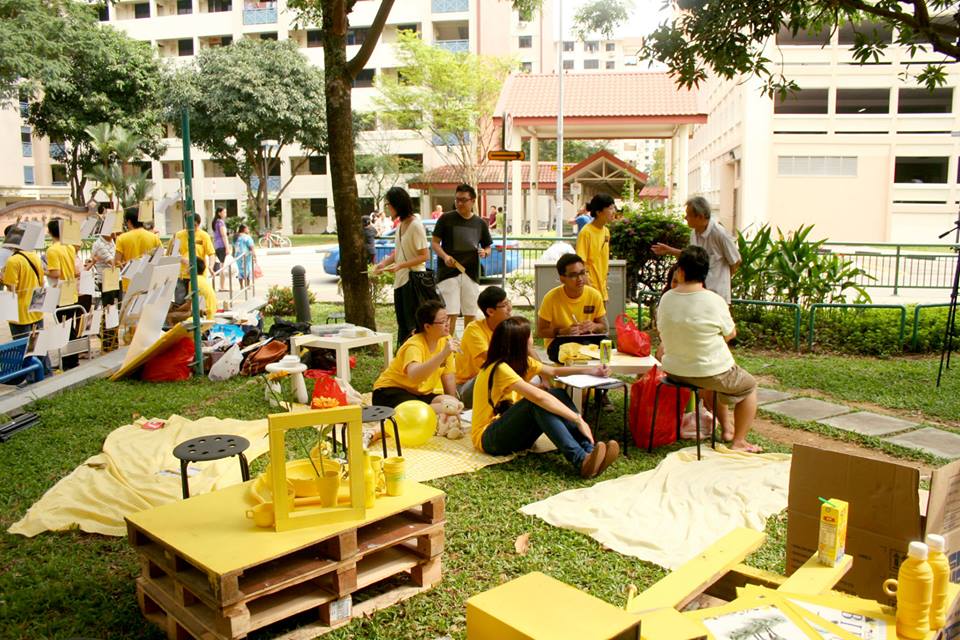
Starting at the level of the neighbourhood, rather than the city, allows us to experiment with smaller but more concrete forms of improving the urban environment through the involvement of regular citizens. Our vision is to make Singapore better, one neighbourhood at a time.
Singaporeans are stereotyped as an apathetic lot. What has your groundwork taught you about getting Singaporeans to be more involved?
We have gained several insights:
Both of you recently went on a whirlwind tour through Australia, USA and Denmark to present BetterSG. Tell us more about what you’ve brought back to your project.
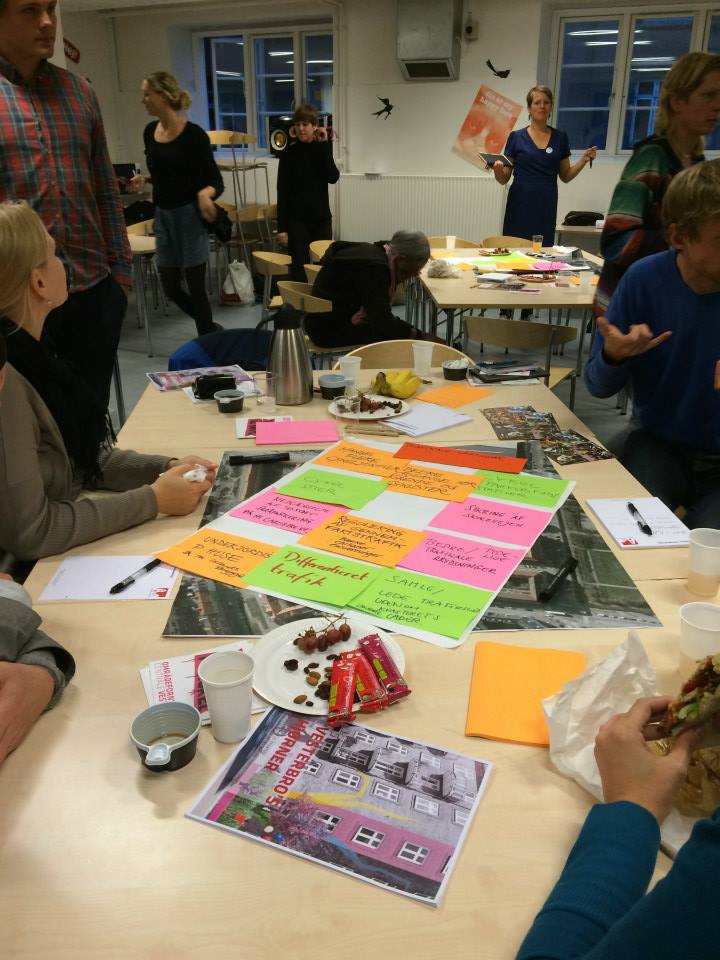
We have received a grant for BetterSG, and we are grateful to have traveled to New York and Copenhagen. The aim of the trips was to study and learn from these cities’ successful projects that have aspects of participatory design and community engagement. From these global case studies we draw learning points that can be adapted and applied to our local context. We seek to understand how participatory design and planning works in New York City and Copenhagen, and what that means for Singapore.
The first step of BetterSG is to understand local practices and perceptions via an online survey to find out people’s thoughts on Singapore. What is your plan for the data?
The data will be used to show people’s perception of ownership to shared spaces and their attitudes towards getting involved and participating in their neighbourhood’s issues. It will form part of our documentation and analysis on the existing landscapes in participation in Singapore. Alongside the data from the survey, we will be analysing local interviews that we have conducted.
The aims of BetterSG and the highlighted interviews with experts read as a critique of how close Singapore’s existing urban planning system is. Even before involving the people, what are some steps the state can take to making a BetterSG?
It would depend on how the state defines a BetterSG and the context of the problem/issue. There is not a one-size-fits-all “steps” or “solution” the state can take. When faced with a problem/issue, I think is not even about trying to find the right answer to a problem/issue, but it is sometimes, trying to identify with precision what is the right question to the problem. Nonetheless, it is not so much the steps the state can take. Perhaps, a change in mindset, values, and having an alternative way of looking at problems on hand would be crucial even before involving the people.
There are already various government arms (e.g. People’s Association (PA) and Residents’ Committees (RC)) working to get Singaporeans involved in their neighbourhoods and committees. As a non-governmental movement, how useful and effective do you think BetterSG can be?
The outcome of the initiative is a BetterSG Blueprint, which will be made available to the public on the BetterSG website, and it will lay out our vision and methods of designing with communities.
The target audience for this framework is any organization/designer/individual who is interested to be involved in designing with communities and creating community-owned solutions. The organizations would include grassroots organization such as PA, RC, volunteer welfare organisations (VWO) and government agencies, etc. The content will be open source, and we are planning for workshops and training to complement the use of the methods and tools in the Blueprint. The aim is to garner more awareness of and interest in participatory design, and lead to commissioned projects and workshops with communities.
With regards to the exciting grassroots structure, we acknowledge that there is potential for existing grassroots organisations to do more in enabling people to step up. We can leverage these existing organisations by introducing new roles that they can play to build up the community’s capacity for participation. We identify existing roles in the neighbourhood and maximise their potential to contribute to the project. This is key to designing community-owned solutions. It is not about creating new structures, but working with the existing grassroots structure that people are familiar with.
We see the BetterSG blueprint to be used in various ways:

Architecture or property are different names for what most of us call a building.
But the emergence of starchitects has blurred the line between the two. Nowadays, there are buildings, and there are buildings designed by famous architects.
The city of Singapore has recently become the home of several condominium towers designed by starchitects such as Rem Koolhaas (The Interlace), Zaha Hadid (D’Leedon) and Jean Nouvel (Le Nouvel Ardmore). Local developers seem to believe that such architects renowned for their avant-garde designs can raise the values of their properties with a touch of designer class.
But what happens when such avant-garde architects meet the property market? Imagine Koolhaas or Hadid selling their architecture to the man on the street. You can’t — that’s the job of real estate agents. And the translation of these architects’ often abstract concepts into market language reveal the gaps between architecture and property.

Consider Moshie Safdie’s Sky Habitat, which became famous as the most expensive suburban condominium in Singapore when it was first launched in 2012.
This is how the project is introduced on a dreary grey backdrop with no photos on Safdie Architects website:
“Over the last four decades, Safdie Architects has created from the experimental project Habitat ’67 in Montreal a series of projects incorporating fractal-geometry surface patterns, a dramatic stepping of the structure that results in a network of gardens open to the sky, and streets that interconnect and bridge community gardens in the air.”
The developer’s website for potential buyers, however, begins like this:

This is just one of several blurbs including “Garden Living from Above” or “Dive into Our Sky Pool” that markets the “sky life” created by Safdie’s design. Selling such a view seems a strategic move considering the apartments are marketed to middle-class Singaporeans who are clueless about Safdie (“also known as ‘Who?’ to 99% of Singaporeans,” said one commentator). They would be familiar with his Marina Bay Sands design, however, a building which introduced the concept of a pool in the sky in a big way to Singaporeans.
Absent from the “sky life” hype, however, are how Safdie’s design attempts to foster a sense of the public amongst its residents with “generous community gardens and outdoor spaces on the ground”, according to the architect’s website. The developer’s descriptions of the design never expand beyond “you” and “your family”, highlighting how architecture is massaged into private property.
This struggle between architecture and property also surfaced in a recent Icon interview with Safide when he revealed that a woman wrote to him for help in getting a loan to buy a Sky Habitat apartment.
“When you take land and construction prices and the costs developers add on, it’s a struggle between affordability and the ideal. Moreover, the development was so desirable when it was built that it immediately became gentrified,” he said.
———–
Written for Elizabeth Spiers and Chappell Elison’s Online Publishing class at D-Crit.