National campaigns — against littering and breeding mosquitoes or encouraging the speaking of good english and to have more babies — are part and parcel of everyday life in Singapore. A new exhibition, “Campaign City: Life In Posters”, celebrates this aspect of the country’s heritage by inviting 50 individuals from its creative community to design posters based on their personal memories of various campaigns. The works are currently being exhibited at the Lee Kong Chian Reference Library, on Level 11 of the National Library Building, until 3 July together with a historical survey from the library’s poster archives.
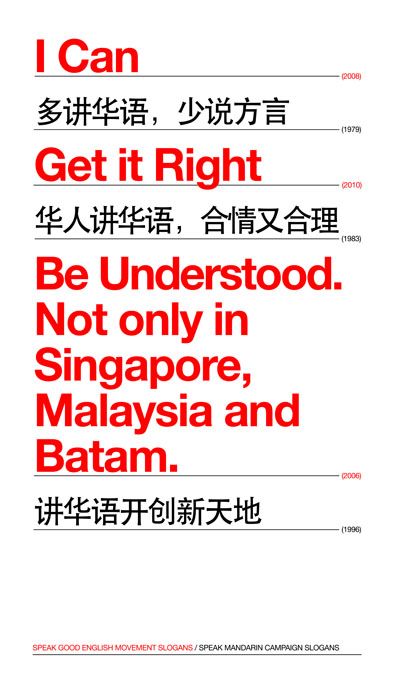
I was fortunate enough to have been invited to contribute a work for this event organised by The National Library of Singapore, in partnership with Salon Projects. Since I was a writer, I figured my best bet would to be create “word art”:
Here’s what this “pledge”, made up of a mish-mash of campaign slogans over the years, meant to me:
As a writer, language is how I define my world. Growing up as a student under Singapore’s two language campaigns — first the Speak Mandarin Campaign, then the Speak Good English Movement — I always felt caught in-between.
The Chinese language was suppose to root me to my ethnic culture, but it was alien to my English-speaking family and my elders who spoke Cantonese, Teochew or Hainanese. When I discovered Singlish connected me with my family and friends in Singapore, I was told to speak English to plug in to the world outside.
Made to grow new roots and taught to cater to strangers outside of home, what have I become? A successful hybrid Singaporean or a failed translation of our bilingual policy?
As the campaign slogans over the years reveal, language for a Singaporean is so we can speak to everyone outside of this city, but never amongst, nor for, ourselves.
One of the biggest issues I’ve always felt about my understanding of design (and even the world) is it has been largely from the view of the West. Living in Singapore where English is our first language, I’ve easily gained accessed to the tomes (and tonnes) of writing about design from Europe and North America. Most of these are not only from the West, but are also about the West, as English-language writers and publishers are only just starting to take notice of the Asian design scene.
A hint that designers from my neighbouring countries might have something else to offer first came when I attended “The Way of Asian Design” forum in Singapore a few years ago, featuring Kirti Trivedi, Ahn Sang-Soo, Lu Jingren and Kohei Sugiura. Then, I chanced upon Kenya Hara’s Designing Design, one of a select few English-language publications from an Asian designer. At the beginning of this year, I discovered Chinese translations of Japanese design books on a trip to Taiwan, and I immediately bought them—assuring myself that my rusty Chinese language I picked up in school would hold me in good stead.
It barely did, especially since the books were in Traditional Chinese script, and I learnt the language in Simplified Chinese. Nevertheless, I’ve trudged through a few volumes of these Chinese-language design books along with other Asian design books over the year and here are some things I’ve picked up, accompanied by interesting related links:
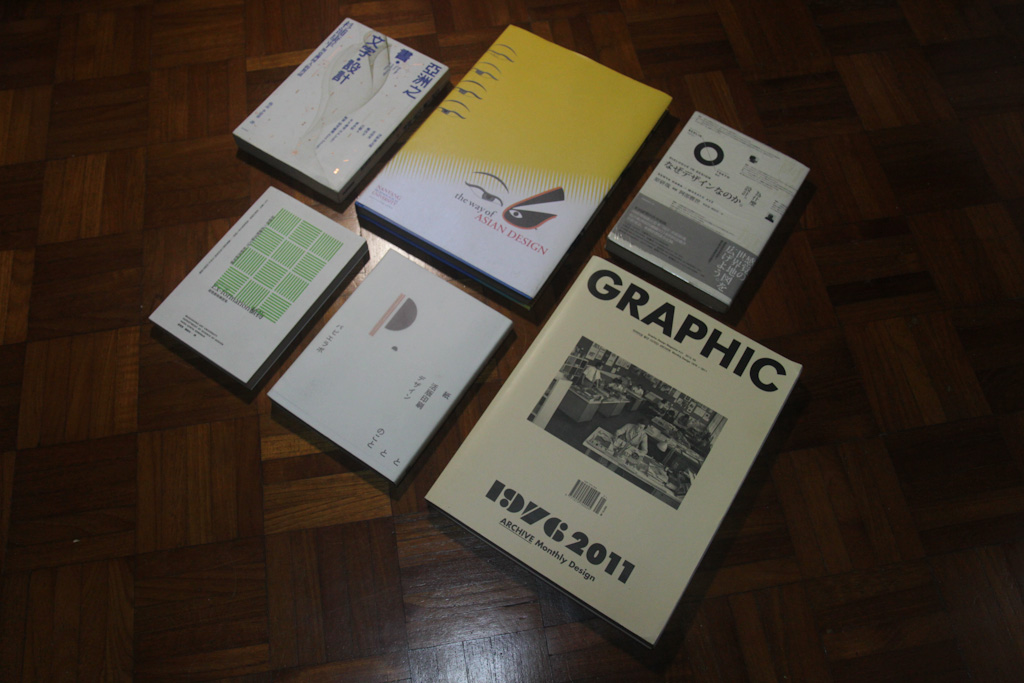
Clockwise from top left: Books, Text, and Design in Asia (2006), The Way of Asian Design (2010), Dialogue in Design: Kenya Hara x Masayo Ave (2009), Graphic Design Magazine #21 (2011), Papier Labo (2010), and Ex-formation: Plants (2008).
Books, Text, and Design in Asia (2006) (亚洲之书。设计。文字) This volume contains the conversations between Japanese designer Kohei Sugiura (杉浦康平) with his contemporaries from Japan (Tsuno Kaitaro 津野海太郎), India (Kirti Trivedi, and the late R.K. Joshi), South Korea (Ahn Sang-Soo 安尚秀 and Chung Byoung-kyoo 郑丙圭), Taiwan (Huang Young-sung 黄永松), and China (Lu Jing-ren 吕敬人). Each of them have been picked by Kohei because he feels they dig deep into their cultural roots to design, particularly in their typography work and books.
The conversations mostly revolve around the history of craft and culture in the respective countries and how each designer has tapped into that for their design work. One becomes aware of the possibilities when designing in the language of a particular culture; and it struck me that the traditional Chinese character is both a graphic and word that represents what it means, which is unlike the Roman alphabet that makes up most of our modern-day languages.
The Way of Asian Design (2010) This is the printed volume of the proceedings that went on during a forum held in Singapore in November 2007. Four Asian designers—Kohei Sugiura, Ahn Sang-Soo, Lu Jingren and Kirti Trivedi— shared their design philosophies and showed how their work were underpinned by the region’s cultures and beliefs. Like during the forum, the speeches have been translated into English, which makes it very useful for those who can only understand Asia through this language.
A standout speech was Kohei’s design philosophy of “one in two, two in one” and “one in many, many in one”, which he attributes to how ancient sages in China and India thought how the universe works, thus the concepts such as Yin and Yang. In Kohei’s case, he compares a book to a universe, which hosts a multitude of characters, stories and elements in a single form, thus “one in many, many in one”. The structure of a book can also been seen as many pairs of pages that extend left and right to top and bottom; and this he says represents sky and earth, beginning and end, past and future. Yet, when the book is closed, this duality becomes one, thus “one in two, two in one”.
Summa Cosmographia (1979). Click on the image to see how Kohei has designed, literally, the entire book.
Kohei then extends this design philosophy to the reader too. He says, “…We readers of books have bodies that reflect this same duality, with the left half and right half. When we pray we join our hands together. In doing so, we unite the right and left sides of our bodies into one. Our body hosts one heart, and this one heart is what we offer together with our prayers.”
It is in this view that guides how he designs his books, which unlike contemporary zen-like Japanese designs are full of colour, details and possibilities—and got me re-thinking what I thought I knew as Japanese design.
Moving from an older Japanese designer to two contemporary ones, this is another conversation-drive book that revolves around Kenya Hara and Masayo Ave, who travelled between their bases of Berlin and Japan to chat about design in the two countries, society and their personal lives. There is certainly a thread here amongst these Japanese designers regardless of generations: how they see design as integral to the way they live. They don’t see it in terms of its “value-add” or how well it sells, or whether it is aesthetically beautiful. To them, design is an expression of values, which makes it such a personal and powerful endeavor.
Reading the conversations between the duo, I found it curious that the Japanese feel design in their country is too insular and needs to make itself understandable to the global arena to survive. Ironically, this is the reverse of what I have been thinking about Singapore, where design is so attuned to globalisation that it has no voice of its own.
These two books are really photo books for me because both are in languages I do not understand.
GRAPHIC is an independent South Korean design magazine started in 2007, and is now trying to reach out to the world by publishing both in Korean and English. The issue I got was Korean-only because it is an “archive” of another Korean magazine, DESIGN, which it regards as a pioneer of the community, having been publishing since 1976. It’s a fantastic flip through 400 of DESIGN’s covers and a selection of Korean works that together paint how the scene has evolved. Unfortunately, I ‘m not able to read the essays, which I can only imagine help to make this issue of GRAPHIC, a significant one in understanding its country’s design history.
As for the Japanese-only Papier Labo book, I gathered from online that it is a custom printing press formed in 2007 in the Sendagaya area of Tokyo, and this is a book that documents the work that goes into this studio. I was simply struck by how beautiful the book is as an object, as well as the photography of the works they have created and studio life.
This is essentially a report of the 2007 edition of Kenya Hara’s Ex-formation project, an annual research he conducts with students at the Musashino Art University in Tokyo to understand how little we know, to question what we think we know and understand. For this edition, the group explores the theme of “plants” and they design a series of projects that present us new ways of looking at them as silhouettes, food, products, and colours—which makes the book a delightfully unexpected page-turner.
———–
If you know of other Asian design books worth checking out, do drop me a comment. I understand Jamie Winder and Iain Hector from Where You Going? are already working on a book about Southeast Asian design after traveling through this area, so that should be something to look out for.
When I first began writing about design, an editor of an Asian design magazine categorised my essays as only interesting to designers. Instead, I needed to re-tune my writing for “design consumers” if I was to write for their magazine.
The remark gave me much clarity in what I sought to write about. I’ve never wanted to sell or promote the coolest or latest designs , but I’ve always seen design as a part of our everyday life, as well as a product of our culture and times . But such a view is rare amongst how many in Singapore view design. One of the most telling indicators for me is how design is often represented in the local mainstream media. When design gets coverage in newspapers like The Straits Times and Business Times, design is usually portrayed as a consumer product: designer furniture, stylish interiors, and dream homes. The same goes for many magazines about design that I find in Singapore.
Such a dominant view of design’s role in society probably explains why there was hardly a reaction from designers and architects over the fact that Singapore sat out of the Venice Architecture Biennale this year. As compared to local artists currently going brouhaha over the government’s decision to pull out of the contemporary art version of the Venice Biennale next year, the response has been rather muted except for some comments elicited for an article on The Straits Times over the weekend (Singapore skips architecture biennale. 1 September, 2012). After participating in every edition since 2004, building national pavilions around themes such as Second Nature (2004), Singapore Built and Unbuilt (2006), Singapore Supergarden (2008), and 1000 Singapores (2010), Singapore designers and architects will not be able to showcase their ideas, culture and work on an international platform this year.
While DesignSingapore Council has chosen to remain “tight-lipped about this year’s non-participation”, its executive director Jeffery Ho told the newspaper that the council was focusing on other events such as the Milan Furniture Fair, Maison et Objet in Paris and International Contemporary Furniture Fair in New York. As Colin Seah from Ministry of Design pointed out in the report, this indicates the council’s direction to concentrate on “more commercial and trade events” — which supports my view that the council has become more interested simply promoting design for economic consumption. From what I understand, the Venice Architecture Biennale has always been an exhibition about ideas in design and its role in arts and culture as opposed to the business of selling design.
This latest pullout follows in the wake of the postponement of what was supposed to be the fourth Singapore Design Festival last year. There is still no news if the council will hold the festival this year, traditionally happening between October and November. What we can say for sure is that policymakers are reviewing their strategy of promoting and supporting design, perhaps aptly so since next year will be a decade since the council was set up.
A cue for the future of how the Singapore government will support and promote design can be found in the council’s plans for the upcoming National Design Centre due in 2013. It seems that government policies are shifting back to the view that design is for commerce and trade alone. This marks a shift in the original agenda set by the council’s late founding director, Dr. Milton Tan.
As one of his staff recalled in a eulogy for him that was published in The Design Society Journal No. 02, “Milton’s eventual vision for Singapore design was formed with the Ministry’s support… His research in design creativity also informed him that a healthy design strategy had to be integrated with culture, craft, and inspiration. This is why Dsg is in the ministry leading the creative industries, and not trade and industry. Though frequently challenged by MICA to deliver the economic numbers when formulating the design strategy for the next five years, Milton continued to push the cultural agenda.”
Could the time be up for the council and it finally needs to justify continued support for design with indicators of how it has benefitted Singapore economically? How will national design policies that ignore culture and affect the industry and community in Singapore?
This is a similar concern raised almost 15 years ago in a 1998 news report in the Business Times reviewing what was then the decade-old International Design Forum held in Singapore, another government initiative for design. The question was asked if the now defunct forum had become “too commercially oriented at the expense of highlighting design in its pure form”.
An optimistic view would be to say the council has laid a foundation and the growing community of designers and architects can continue cultivating the seeds of cultural evolution. But has the scene arrived at this point? It’ll be sad to see the council’s decade-long work of pushing design beyond the realm of business go to waste, but what is even more painful is to realise this is something that has happened before. And likely to happen all over again.