Since British advertising agencies brought modern graphic design into Singapore after the Second World War, a thriving community of independent studios has emerged in this former colony in Southeast Asia. Today, Singapore is a modern metropolis set to celebrate fifty years of independence in 2015, but the nation-state is still struggling to create a distinct local identity while earning global recognition— just like its contemporary graphic design scene.
Two separate exhibitions held by Singapore’s top graphic designers in the 1990s and 2000s show how the profession had changed within a decade in the city-state. In 1994, Su Yeang paid her own way to hold “Breaking Barriers” in The Design Centre, an exhibition of Su Yeang Design’s work to educate the public and businesses on the importance of good design. It reflected a time when graphic design was seen as a problem-solving tool for businesses. Fast forward to 2005, :phunk Studio held “A Decade of Decadence”, a retrospective exhibition of their “Greatest Hits”. Besides the influence of music, this exhibition held in the Singapore History Museum was supported by entertainment establishments Zouk and MTV, as well as Tiger Beer. As William Chan of :phunk then said: “When we started, people thought all graphic designers could do were design ‘Big Sale’ flyers and lay out text on posters. But these days, we are viewed as trend-setters.”
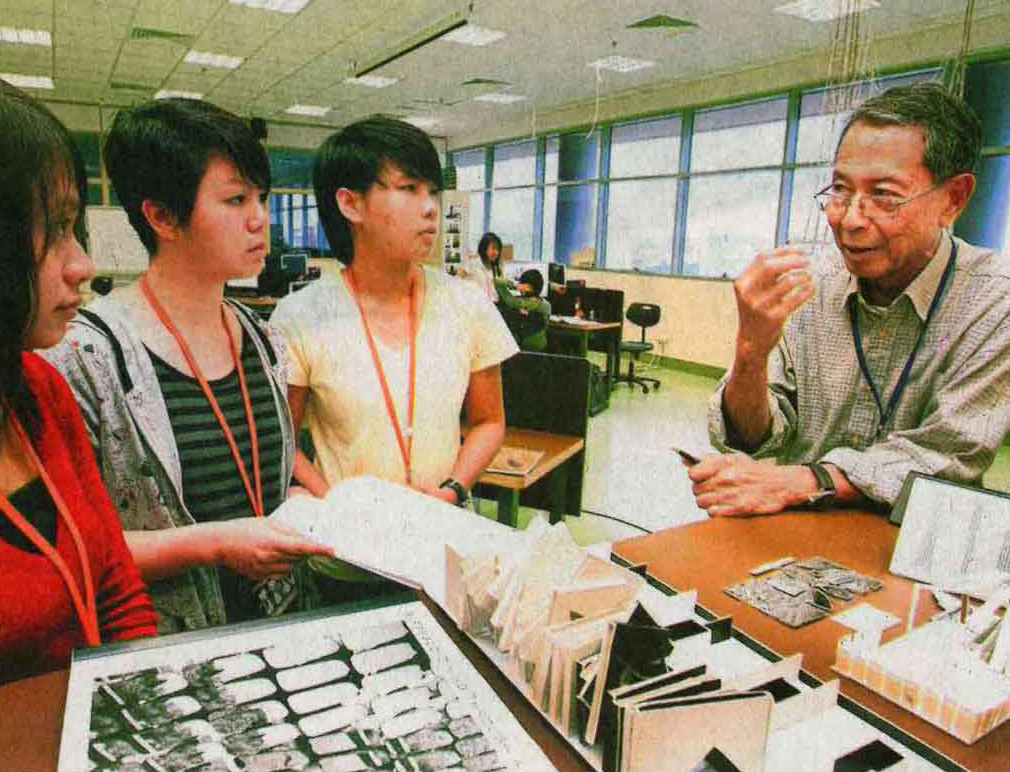
A 73-year-old Sannie Abdul talking to his students at Nanyang Polytechnic. | BERITA HARIAN
He barely completed primary school, but that did not stop Sannie Abdul from rising to become the government’s chief promoter of Singapore design.
For over two decades, Sannie spearheaded the state’s efforts to introduce design to businesses in Singapore, first as the head of the Industrial Design Centre in the Singapore Institute of Standards and Research (SISIR), and later, as the director of the Design Centre.
Too poor to afford education after primary school, a young Sannie began working as a clerk in a private company in 1950. According to a 1977 profile in Berita Harian, he left after a year to dabble in photography with the Singapore Photo Company before ending up as a technician for a civil engineer. During this period, he also began studying part-time in Singapore Polytechnic to be an architecture technician, and eventually joined the studio of Architects Team 3.
Sannie first got involved in the development of design in Singapore when he joined the industrial design department of the state’s Economic Development Board (EDB) in the 1960s. As part of Singapore’s industrialisation efforts, Sannie and his team helped local manufacturers design better Made-in-Singapore products and also promote good design to the public via the Product & Design Centre in the John Little Building. By the 1970s, Sannie rose to become head of the department, which by then came under SISIR, the state’s science and research arm.
There was much work to be done, recalled Sannie during a 2010 interview.
“In the early days, when people look at design, they always say ‘modern design’. Modern is something new. They will say, ‘Oh, this is very modern.’ But I think people still far from understood what is good design,” he said.
While working to raise the state of design in Singapore, Sannie also continued upgrading his skills in design. He obtained a grant from the Asia Foundation to study industrial design and architecture in Chicago’s Illinois Institute of Technology, and in 1973, he worked for six months in Italian design group, Olivetti, with the help of a United Nations scholarship.
This logo was designed by Sannie for the Singapore General Hospital to commemorate its 50th anniversary in 1976.
When he returned to SISIR, Sannie worked with a pioneering team of Singapore designers, many who went on to start their own design studios, to provide consultancy services to government agencies and local companies. Some of the group’s work included exhibition design for the Singapore Fairs, interior design of the Central Provident Fund building, and the logo of the Singapore General Hospital, which was credited to Sannie.
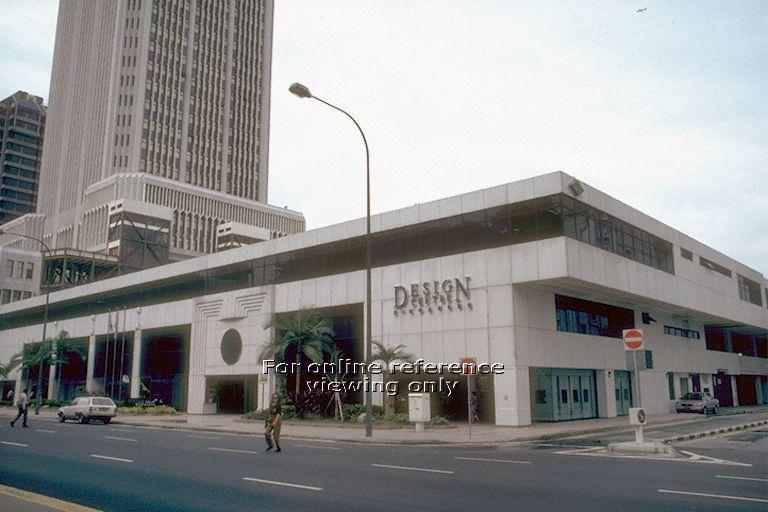
But what Sannie is most remembered for was his work in running Singapore’s short-lived Design Centre from 1992 to 1995. It was the culmination of the state’s renewed efforts to promote design after it privatized SISIR in 1981. Sannie had left briefly for private practice, but was called back in 1984 by the newly established Singapore Trade Development Board (now IE Singapore) to continue work on promoting design to local businesses. Working with the recently founded Designers Association Singapore (now the Design Business Chamber Singapore), many of its founders whom Sannie knew personally, he helped the government kickstart several initiatives that brought attention to Singapore design. In 1989, TDB launched the biannual International Design Forum which brought leading design nations such as Germany and the United Kingdom, as well as top designers including New York’s Vignelli Associates and Japan’s GK Industrial Design to showcase their work in Singapore. Three years later, the government opened a Design Centre along North Bridge Road with Sannie directing the creation of exhibitions and a design library, which was a rare source of books for local designers in the pre-Internet age. For his efforts, Sannie was elected to the executive board of the International Council of Societies of Industrial Design (ICSID) in 1993 for a term of two years.
The Design Centre opened along North Bridge Road in 1992 and closed only three years after. Over two decades later, the government would open a new National Design Centre along Middle Road.
After a decade of promoting Singapore design, Sannie left the Design Centre and soon joined local branding agency, Su Yeang Design to help it expand overseas. The Design Centre closed six months after he left, reportedly because of a shortage of funds. When asked about it a few years ago, Sannie said, “To me, it’s a pity, they built up a certain level, and it was recognised internationally, and it just went poof. It had become like a hub for young people to meet. You have activities, seminars, workshops…”
Even after leaving the government, Sannie’s desire to improve design in Singapore never died. After trying to retire in Melbourne, Australia in 2006, he found his way back to Singapore and started a second career as a lecturer at Nanyang Polytechnic’s School of Design at the age of 70. He taught full-time for several years before passing away last Wednesday on August 20.
Before Singapore became a city of glass and steel skyscrapers, it was a town built out of bricks made on the very shores of this island. “Our Brick Estate” is an on-going exhibition traces the history of this construction material in Singapore, rebuilding the history of the local brick industry by assembling a collection of Made-in-Singapore bricks at the library@esplanade. Architectural and urban historian Lai Chee Kien, who curated this exhibition, tells us more.
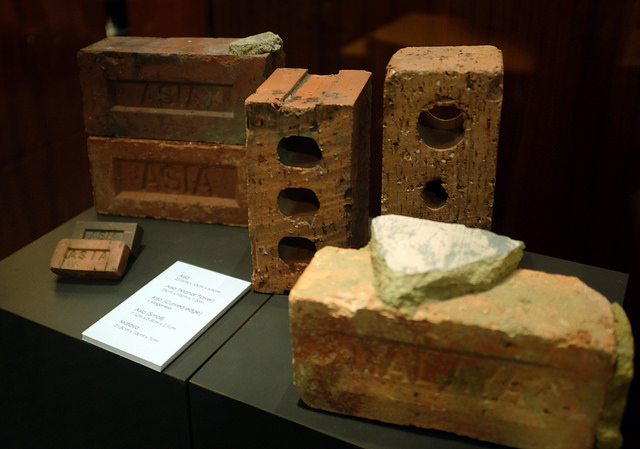
A collection of Made-in-Singapore bricks are on display at the “Our Bricks Estate” exhibition through the end of August. | PUBLIC DOMAIN
How did this exhibition come about? The library@esplanade has seven vertical glass showcases used for exhibition every August for topics related to National Day. This year, a friend — Ms. Khoo Ee Hoon, suggested I curate one about bricks found in Singapore. She had heard my comment while documenting Bukit Brown Cemetery tombs, that bricks of all types from Singapore could be found there. She was also an avid collector of these bricks.
Where did you find the bricks for this exhibition? The bricks came from several collections including Ee Hoon’s, those of Mr. Jevon Liew, and those excavated by a friend, Dr. Anoma Pieris, in 2001 while working on the former convict prison site at Bras Basah during the construction of the Singapore Management University. Together, they constitute an almost complete collection of bricks from most of Singapore’s important brick factories after World War II, as well as the early hand-made bricks which were thinner (about 1.5 inches thick) and coarser in finish.
Why were bricks made in Singapore? Even during the classical Malay kingdom period when structures were constructed on Fort Canning, bricks would have been used. In 1822, the first Town Plan of Singapore mandated permanent materials to be used, and various brick kilns were set up around the Rochore-Kallang river areas. In 1858, the colonial government started its own brick factory, and the industrial methods produced bricks good enough to win prizes, as they did in Agra exhibition in 1867. Bricks were continually used in construction as many areas in the southern and western areas of Singapore had good quality clay to be used as raw materials for the bricks. There was a labour and price crisis in the 1950s when many factories closed, but the next decade onwards saw a rekindling of the industry when the Singapore government embarked on a large scale development programme including housing. By 2000, however, the factories’ land in Jurong and Choa Chu Kang were acquired to create new housing estates.
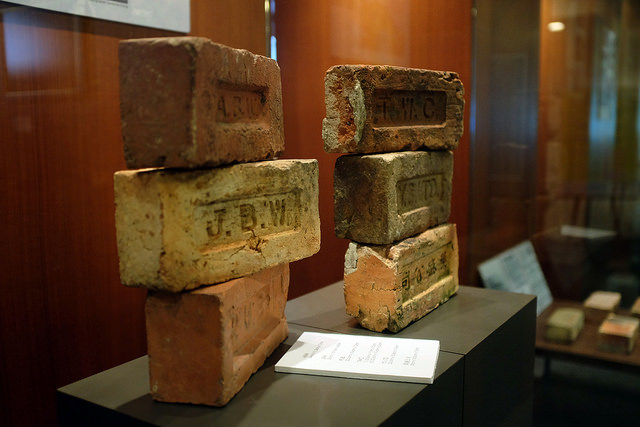
Brick makers in Singapore often printed their names onto the bricks themselves | PUBLIC DOMAIN
What were bricks made in Singapore like? Were they unique in anyway? (e.g. material, quality) They were various types of bricks made in Singapore, including white bricks using a different clay. I think the development from the traditional kiln to more industrial kiln types, like the Hoffman kiln and later the tunnel kiln, made quality control a mainstay. For example, even though Asia Brick Factory at Jalan Lam San occupied only 10.3 hectares of land, it was able to produce around 37 million bricks annually in the late 1980s, when they employed a tunnel kiln.
Who were Singapore’s brick makers?
They varied from convict labour used to make the earliest bricks, to small-scale Chinese brickyards all over the island during the colonial and inter-war periods. Investment from elsewhere was also used to finance them. In 1972, sensing that it would be better for their supplies, the Housing & Development Board purchased a factory to make its own bricks and to prevent price fluctuations. At one point in time in the 1980s, the demand for bricks was so great that millions of bricks had to be imported from elsewhere to feed the construction industry.
What was the extent of Singapore’s bricks industry? The factories were located in the southern areas of Singapore (Bukit Merah and Alexandra, for instance) and in large areas in the west. There was one in the Upper Serangoon area and earlier ones adjacent to the Rochore and Kallang Rivers. Most bricks were produced for use in Singapore, but companies have been known to supply bricks to Malaysia and elsewhere.
Where is Singapore’s brick industry today? There are no more brick factories in Singapore today, as bricks are now all imported from overseas. Their characteristic tall chimneys and sprawling drying yards can no longer be seen. There are still kilns, but these are used more for firing ceramics, like Thow Kwang in Jurong.
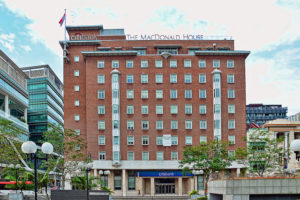
The MacDonald House was completed in 1949 with locally made bricks, and has been gazetted as a national monument. | CHOO YUT SING
What are some buildings still standing today that used these Made-in-Singapore bricks? The many HDB flats all over the island would have them — these are the ones built before pre-cast panels and components were used in the 1990s. MacDonald House, the old Central Fire Station, old shophouses and even the National University of Singapore campus uses a lot of bricks as a primary construction material. You can see an exposed brick archway at The Arts House, which was completed in 1826 using probably imported bricks. A lot of bricks are plastered up nowadays so you can only see the plaster work and not the bricks that were covered up. Many others have known to paint over facing bricks for their homes and other buildings.
How can we identify a Made-in-Singapore brick?
We can mainly tell by their factory names imprinted onto the brick recess. Some of these include: Alexandra, Jurong, Nanyang, Sin Chew, Malayan, Asia, Goh Bee, Kim Lan, and Tekong, etc.