Category: History

Through the lens of The Straits Times

Just over two weeks ago, Straits Times launched Through the lens, a micro site that features the work of its photojournalists as well as the best pictures from around the world. Today, visuals and multimedia proliferate our world and have also become an integral part in telling the news. In recent years, the latest camera technology that combine photography and videography has also given rise to “multimedia storytelling” — the use of images and audio to present a story (But isn’t it still video?). More and more, photojournalism is no longer just about having a spread on the newspaper or a photo gallery online, and ST is not alone in doing this, The New York Time started its Lens blog over a year ago.

For me, what’s unique about Through the lens is its Flashback section. A media institution like the Straits Times probably holds the biggest archive of pictures of Singapore’s history, and it’s great to see it finally come to public light. Thus far, you can see what the National Stadium, Hong Lim Park, Miss Worlds, and even how flooding looked like in the past. These photos help to add historical context to some of the recent issues the print stories have brought up.

Through the lens is an important development for ST’s photojournalists. They have long been seen as sidekicks to the journalists who write the story, yet, people remember photos and are drawn to it first before even reading the news. This website finally gives ST’s photojournalists their own platform to showcase more of their photos, as many often do not make it to print. More importantly, it gives them their own voice to author their own stories. Many of the photo essays and multimedia currently up were done in conjunction with print stories. However, there are now some web-only and photo-only stories. One that caught my eye was Kiddy Rides, a on-going photo essay documenting the colourful machines that would rock children for a few minutes with music. These are gradually disappearing from Singapore after a 2007 shophouse fire in Hougang led to a tightening of rules on how spaces outside shops are used. This is a story that is definitely more interesting visually than in print and Through the lens and opens up an avenue for work-in-progress photo collections.
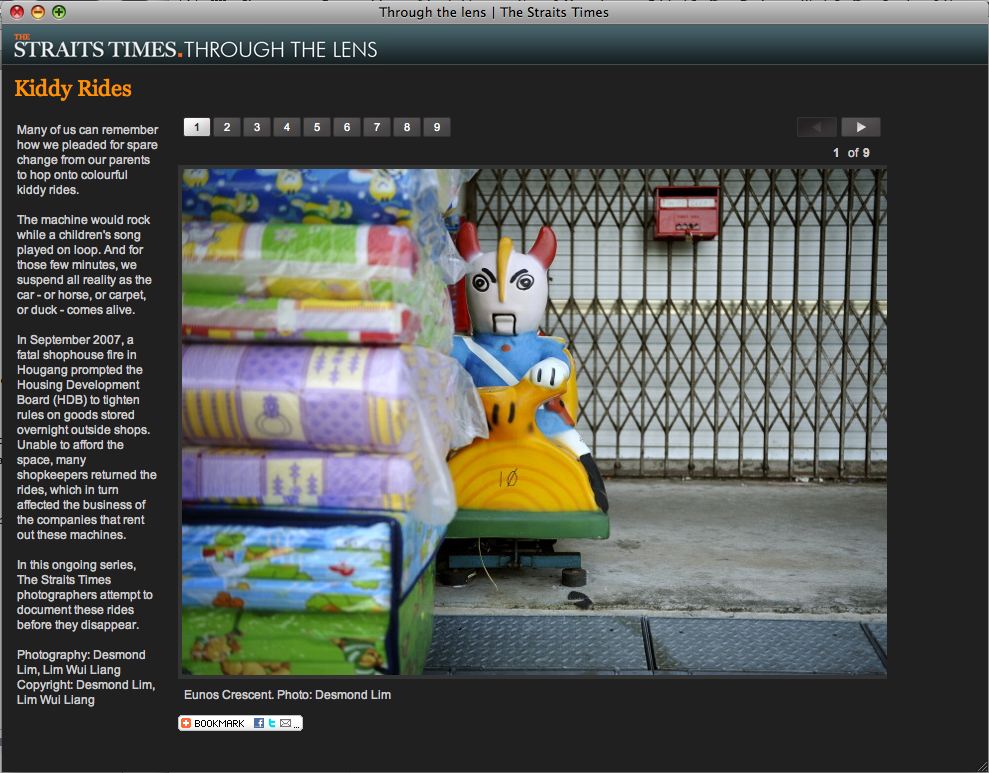
Kiddy Rides

It’ll be interesting to see how Through the lens develops in the coming months. Will it be actually enhance the role of photojournalism in ST or become a container for the paper to keep photojournalism online? From what I understand, this site means more work on top of the daily assignments for the photojournalists, so it’s really a labour of love now more than anything that is keeping it alive currently.

Talking Back To The State

National campaigns are a big part of life in Singapore. Even before independence, the government had began using all sorts of campaigns to create model citizens and to shape the city to its vision.

In the 1960s, Singaporeans were exhorted to eat wheat when rice was in short supply. The 1970s a Speak Mandarin campaign was introduced to encourage the Chinese community to use Mandarin instead of dialects. This was then followed by the National Courtesy Campaign in the 1980s where Singaporeans were told to be courteous to one another. Campaigns died down a little from the 1990s, but a significant one in recent times was after the 2003 outbreak of Severe Acute Respiratory Syndrome (SARS) when Singaporeans were encouraged to ‘Step Out’ and resume their daily lives.

A Straits Times article in 2003 counted some 200 documented campaigns between 1958 and 1995, and anyone in Singapore since the 1980s would have been exposed to an average of more than 10 national campaigns a year! But such campaigns have largely been a one-way communication from the state. A new exhibition, Campaign City: Life in Posters, finally gives voice to the target audience. Ten local artists were asked to re-interpret a national campaign that they remembered in the form of a poster, an essential marketing collateral before the day of television and the Internet.

Campaign-city-Ian

Ian Woo’s response (left) to the 1970s campaign against the hippies culture (right) that even saw musician Kitaro sent home when he came to perform in Singapore with long hair.

While artists like Michelle Fun, :phunk studio, eeshaun, and Ian Woo re-appropriated old campaign posters, others like Messy Msxi, Zhao Renhui and Clare Ryan created new work in response to the original campaign slogans. The 1970s ‘Two is Enough’ campaign, which encouraged Singaporean families to stop at two babies, was the most popular campaign as Justin Lee, ampulets, and Randy Chan each did a poster for it. This campaign is arguably one of the nation’s few successes, so much so, that low fertility has become a problem for Singapore today.

While the posters are personal responses, when read as a collection, there seems to be an underlying sense of ambivalence and pessimism about these campaigns. Randy’s poster (below) was especially memorable, visualising the many campaigns in the form of a condom — a critique on how a protective nanny state not only denied fertility but life in this city too.


Campaign-city-RandyYet, one cannot deny the iconic value the old campaign posters have left in our visual culture. They may never have been very effective in moulding society and its people in the way it was meant to, but it has certainly helped shape how we see this city.

Campaign City: Life in Posters
9 Sep – 15 Oct
Tue-Sun, 2pm-8pm
Evil Empire, 48 Niven Road

William Lee: The Father of Singapore Logos

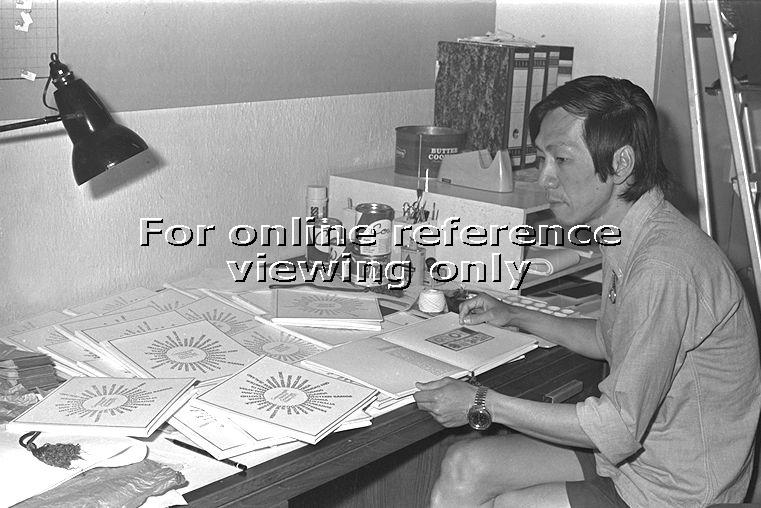
william leeA 1971 photo of Mr William Lee at his River Valley flat-cum-studio

“A logo has to be international. It has to be understood in one look,” said graphic designer Mr William Lee in 1987 when asked what made up a good logo. By then the 45-year-old had already a portfolio full of logos, many that still remain in use today. Some of the logos he designed include that of the Post Office Savings Bank (1972),  the Singapore Bus Service (1978) logo, and the Citizen Consultative Committee (1986).


The graphic designer set up his own design house, Central Design, in the 1970s, and it was a firm synonymous with logo design in Singapore. Besides these three logos, Mr Lee is also said to have designed those of the Shangri-La Hotel, the Singapore Cultural Foundation, the Singapore Armed Forces Reservist Association (SAFRA), the Singapore Institute of Standards and Industrial Research, and Overseas Union Bank, amongst others.

For his contributions, Mr Lee was awarded the Public Service Star in 1975.

If Mr Lee is alive today, he would be almost 70-years-old. Does anyone have any news about him? I would love to track him down for an interview.