Category: History

Old Playgrounds in Singapore

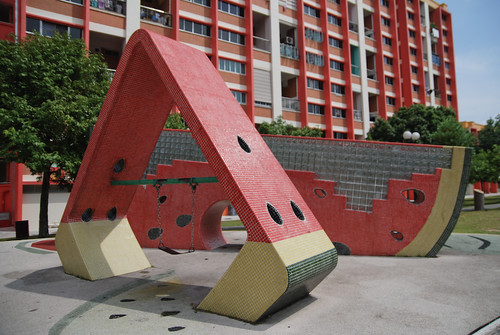
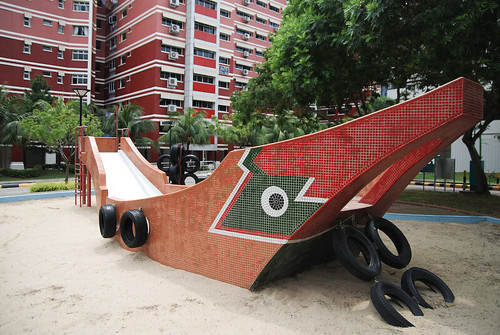
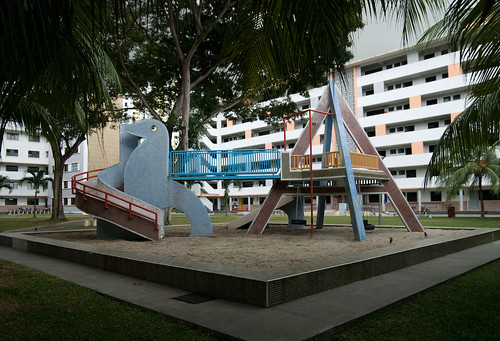
Dragons, watermelon, bumboats and doves — these were just some designs of public playgrounds built from the 1970s to early 1990s in Singapore. Built by the HDB, they were based on local themes and icons, and were unique spaces for a generation of Singaporeans who grew up with fond memories of them.

This is an on-going project. View photos of the playground and  find them to relive your childhood!

UPDATE

Read my article at CNNGo for a short history of these playgrounds or my Singapore Architect essay on what we’ve lost with their passing. Also in the works — a more detailed history of the playgrounds and I may have tracked down its designer…

A Design of Its Time

Keeping up with the times – the changing look of Singapore’s longest surviving English newspaper The Straits Times.

— — — —
First published in  The Design Society Journal,
and edited into seven posts for this site.
— — — —

A newspaper is often seen as a mirror of its society. While this usually refers to the content of the paper, what is often passed over is how its appearance is part of that reflection too.

If you stop reading the newspaper for a moment and examine its overall look and individual elements instead, you would notice how its nameplate, the type of underlying grid, choice of typefaces, and even the paper’s size come together to shape the experience of the newspaper that we take for granted in our daily read.

“Any newspaper we read conveys its personality through the accumulation of these visual cues,” writes visual communications professor Kevin G. Barnhurst.[i] “We assume that it is the writing that makes the difference, but that is only partly true.”

Yet newspaper design is more than its aesthetics, it is a means to convey a message, summed up in former editor of Britain’s The Sunday Times Harold Evans’ observation, “[D]esign is part of journalism. Design is not decoration. It is communication.”[ii]

It for this reason that newspapers, like The Straits Times (ST) in Singapore, have periodically spent money and time to redesign its product.

Explaining ST’s 1998 redesign, then editor Leslie Fong wrote: “The short answer is that we have to – if we wish to stay on top of the competition and give you a better paper.” He adds, “And the competition is not just against other media or information providers but also, increasingly, for your time.”[iii]

A newspaper’s design thus becomes a visual expression of its readers’ values and environment that the paper operates within. Each design change is a deliberate move driven by the need to stay relevant to its readers. In a sense the changing looks of the 164-year-old ST, the oldest English newspaper still around, serves as an archive of how Singapore has changed from a British colony to an independent First-World nation today.

— — — — — — — — — — — — — — — — — — — — — — — —
Introduction } 1960s } 1970s } 1980s } 1989 } 1998 } 2000s
— — — — — — — — — — — — — — — — — — — — — — — —

  • [i] Kevin G. Barnhurst, Seeing the Newspaper, New York: St. Martin’s Press, 1994.
  • [ii] Harold Evans, Book Five: Newspaper Design, 5 vols., Editing and Design: A Five-Volume Manual of English, Typography and Layout, London: Heinemann, 1973.
  • [iii] Leslie Fong, “The Aim: To Give You a Better Paper ” The Straits Times, March 22 1998, HOME, 23.

— — — —
A Design of Its Time — 1960s

Keeping up with the times – the changing look of Singapore’s longest surviving English newspaper The Straits Times.

— — — — — — — — — — — — — — — — — — — — — — — —
Introduction } 1960s } 1970s } 1980s } 1989 } 1998 } 2000s
— — — — — — — — — — — — — — — — — — — — — — — —

Finding a national voice

In 1959, with a gothic-typeface nameplate, vertical eight-column layout and Bodoni Bold and Century typefaces anchoring the headlines, ST looked very much like a British paper.

This reflected its heritage and the fact that it was founded and managed by expatriates, even if run by local English-educated journalists. The paper was largely designed by then managing editor Khoo Teng Soon, also known as T.S. Khoo. Influenced by London’s Daily Express’[i] layout style, Khoo capitalised ST’s lead story headline and stretched it across the entire width of the cover – just like the Express.

But this look was set to change in the same year that Lee Kuan Yew came to power leading Singapore as a self-governing state. Lee had always regarded ST as a British paper and he was suspicious of the paper’s loyalties and place in a nation aspiring to independence with Malaya.[ii]

In a possible attempt to shed this British image as a wave of nationalism swept through both territories, the ST of the 1960s evolved from the Express model. In order to survive as “Malaya’s National Newspaper” circulating both in Malaya and Singapore, it had to look less British.

As Evans observed of a late 1960s edition of ST, “This Malayan morning paper used to be modelled on the London Daily Express, with even bigger banner headlines. It has now gone into lower-case, gaining emphasis for the lead by bringing the weight down the page.”[iii]

No longer emphatically Express-like, ST explored other means to express the drama of its time – more white space, lowercase letters and larger type size. This further culminated in a change of its editorial voice in March 1968, where its three stuffy single-column Editorials became set apart on the left-hand side of the page and given more space to breathe.

At this time, the paper was still serving two different territories despite the failure of the merger between Malaysia and Singapore in 1965. However by the end of the same year, the failed merger would come to be reflected in its changed tagline from “Malaysia’s National Newspaper” to something more ambiguous – “The National Newspaper”, while still hanging on to a nameplate leftover from colonial days.

— — — —

  • [i] Mary Turnbull, Dateline Singapore: 150 Years of the Straits Times, Singapore: Singapore Press Holdings, 1995, 154-157.
  • [ii] Ibid.
  • [iii] Evans, Book Five: Newspaper Design, 128.

— — — —