Been busy of late with several projects on hand, some to keep me going financially, some to keep myself challenged, and others just because I’m excited about them. Here’s one that will be on-going for a long time to come:

Been busy of late with several projects on hand, some to keep me going financially, some to keep myself challenged, and others just because I’m excited about them. Here’s one that will be on-going for a long time to come:
While trawling through the Picture Archives Singapore Database for some research on past elections, I came across these two comics that were part of the People’s Action Party (PAP) 1963 elections campaign.
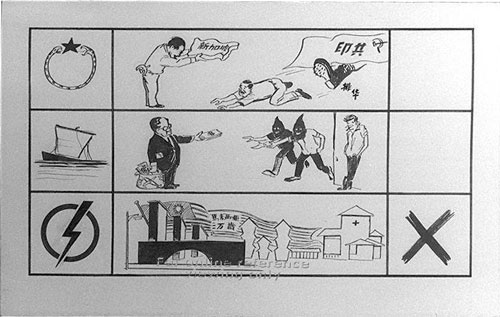
This comic resembles a polling card and persuades voters to choose the PAP (marked with a ‘X’) by equating its logo with a modern city of schools, HDB flats, infrastructure and religious sites. As this elections was held just five days after Singapore merged with Malaysia, the city’s background appropriately depicts the Malaysian flag.
In contrast to the PAP, the comic also illustrates its opponents the Barisan Sosialis and the Singapore Alliance as communists and corrupt respectively. The Barisan’s logo becomes a two-headed snake and is accompanied with a graphic that shows them presenting Singapore to the communists. As for the Singapore Alliance, its boat logo has weak sails, while its candidates are depicted as rich people who give away money to hooligans.
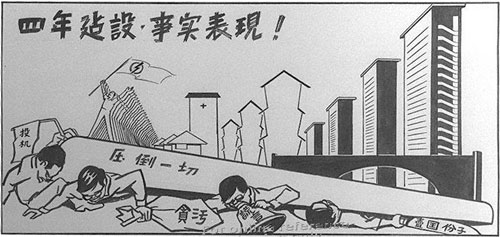
This second comic promotes the progress Singapore has made under PAP’s rule since it came into power in 1959. Again, the image of the modern city is used, this time in the background, while the foreground shows how corruption, lies and the unpatriotic have been crushed or surrendered.
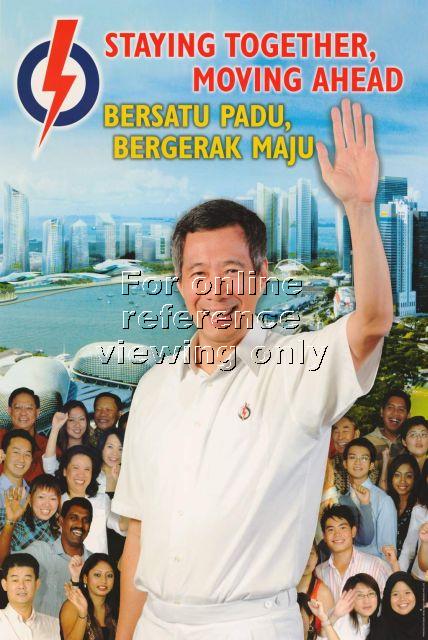
Comparing these comics with how election posters evolved over the years, there is a shift towards ‘looking objective’ and ‘professional’. Nowadays, campaign materials make no reference to the opponents, and photographs are used instead, even if it’s a composed image like the this 2006 poster. Of course, another reason is because these technology (e.g. Photoshop, photography) are now more readily available than in the ’60s.
If there’s one thing that hasn’t changed in these posters is the use of the modern city as a backdrop in a PAP election visual — a reflection of urbanism as a integral tool of this political party.
While the setup of the DesignSingapore Council in 2003 has helped design grow in Singapore, what is less discussed is the role the arts and cultural policy has played. The 1989 Report of the Advisory Council on Culture and the Arts set things in motion by establishing the hardware for a local arts and culture scene, and this was followed by the 1999 Renaissance City Report that gave it the necessary software. In the last two decades, designers have benefitted from the government’s cultural policy, growing closer to their cousins in the arts and culture scene, and allowing them to cross-pollinate ideas and foster a creative community — or what has been once termed the ‘Singapore Supergarden‘. Of course, the loosening of censorship law over the decades has allowed more forms of expression and created more opportunities for designers to pursue creative excellence too.
Today’s report on the Straits Times about the recently setup Arts And Culture Strategic Review Steering Committee shows how much design has grown. Two of the 19 members in this committee that will “formulate concrete strategies to mould distinctive peaks of excellence that would differentiate and distinguish Singapore as a global city and nurture the creative capacity of people at all levels” are graphic designers: Chris Lee from Asylum and Theseus Chan of WORK. The rest of the committee is made up of members from the media, architecture, film, arts schools, and public service officers. Interestingly, there are no artists in this line-up to shape polices that will define Singapore’s arts and culture scene in 2025.
Could the favouring of designers over artists in the committee reflect an arts and cultural policy driven by economics? If it’s creative capacity we are seeking, shouldn’t artists be at the forefront of it and leading this committee? But if it’s artists grounded in a sense of economics we’re looking for, then a designer makes perfect sense — after all, in the past ‘graphic designers’ were known as ‘commercial artists’.