Category: Design

In Singapore, Residents Create a Social Distancing Wayfinding Language With Tape

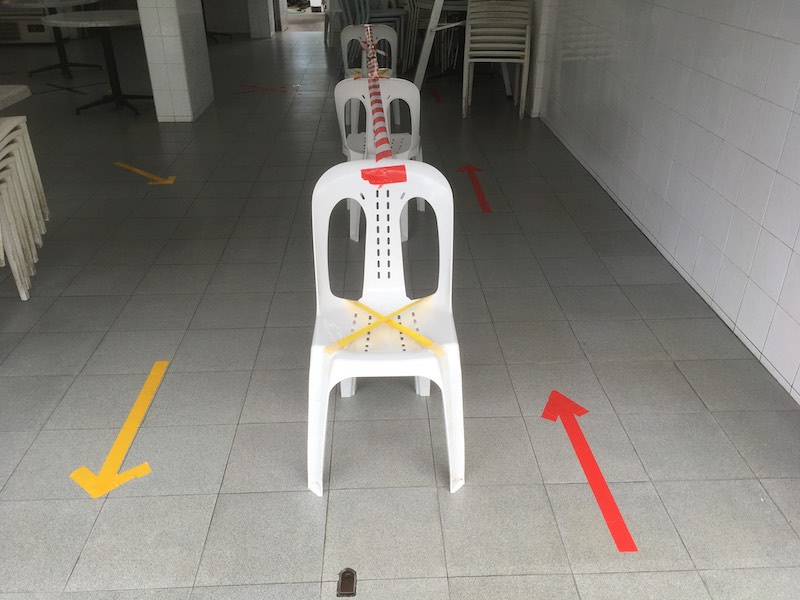
Dots. Lines. Crosses. Boxes. They have popped up all across Singapore over the past few weeks. Plastered over furniture, floors, and more, the city-state renowned for its cleanliness and order has become a maze of symbols, in order to defend its inhabitants from the COVID-19 pandemic.

This “mess” is indeed a series of messages. They tell citizens to stay apart from one another as the city battles to control the spread of the virus. Such makeshift signs started appearing right after the government introduced safe distancing measures on March 20, in order to limit the number of people gathering in a space and keep them at least 1-metre apart.

With just two-days notice before the measures turned into law, and no specific guide on how to implement them, local businesses and organizations quickly found their own solutions. While some printed custom signage to explain the measures, the most popular method has been to use adhesive tape to construct symbols, from crossing out seats to drawing queue lines and cordoning off areas.

Read the full story in AIGA’s Eye on Design

#ADesignLibrary: Designing With People, And Not Just for People

In my early encounters with @participateindesign (P!D), I recalled thinking they were a cross between a “ground-up People’s Association” and a “21st century SPUR”. These were the polar opposite models of community engagement in Singapore: the former a top-down state apparatus while the latter was a citizen-led think tank in the 1960s and 1970s that frequently challenged state planners with its alternative proposals, much to their chagrin. Against this antagonistic legacy between state and civic society, meeting P!D founders @mizahrahman_ and @janhlim in the 2010s was a breath of fresh air. Their cheery dispositions, aptly captured in their bright yellow “brand” colour, were matched by a clear and simple mission to design with people (including the now more receptive state planners). Over the years, it has been inspiring to see their work grow and I even had the pleasure of editing their 2016 publication “Designing with People and Not Just for People”. It’s an important contribution for a new generation of “woke” Sinngapore designers keen to engage people in their work.

Mizah may have tragically left us too early, but her vision still lives on through this book and the P!D team like @jensullivann and @archited88. This #ADesignLibrary post is dedicated to all of you.

#ADesignLibrary spotlights lesser known design books, and invites public access to my personal collection of titles that focuses on Singapore architecture and design, Asian design, everyday design, critical and speculative design as well as design theory and philosophy. I welcome enquiries and physical loans.

#ADesignLibrary: A New Program for Graphic Design

Graphic design has traditionally been dismissed as “surface”, a subject more concerned with aesthetics more than anything else. Thus, a part of contemporary design education is often devoted to studying the profession’s history and theories to prove its deep connections with the world we live in. “A *New* Program for Graphic Design” by designer David Reinfurt (2019) is a “textbook” that sets out to do just that. Based on a series of three courses originally developed to teach graphic design to liberal arts students at Princeton University, Reinfurt takes us on an alternative path from graphic design as a commercial art to view it as an “interface” where various disciplines meet. He holds up the likes of printer-publisher Benjamin Franklin and designers Bruno Munari, Lazlo Moholy-Nagy and Muriel Cooper, to show how graphic design has also historically been produced at where it meets with printing, photography, art, mathematics, computing and engineering. Abandoning the authoritative air of traditional texts for education, Reinfurt invites students to explore the network of rabbit holes he has personally dug— and to arrive at their own conclusions on what graphic design has become.

#ADesignLibrary spotlights lesser known design books, and invites public access to my personal collection of titles that focuses on Singapore architecture and design, Asian design, everyday design, critical and speculative design as well as design theory and philosophy. I welcome enquiries and physical loans.