Category: Design

Lookback: Singapore Design Magazines

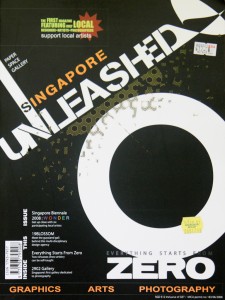
The media is often regarded as the first scribes of history, and is a resource in understanding what things looked like at a certain period of time. A friend recently shared Singapore Unleashed, a 2008 publication that prided itself as the “The first magazine featuring only local designers<artists<photographers”. In it, founders Remie Ng and Eric Wan lamented on the fact that there are “so many wonderful designers, artists and photographers in Singapore”, but most people could not name any. Its magazine would be “a platform for our creative people to showcase their works” and it was a firm believer in the ability of print to show graphics and photographs even though it recognised the power of the Internet. In its inaugural issue, the magazine conducted interviews with artists who were part of the Singapore Biennale 2008 that year,  design agency 19Blossom and also then a newly-opened 2902 Gallery.

This publication stands in contrast to another Singapore-based magazine, SPUNK UNITED, which showcases art and culture around the world. This annual online-only publication run by editor Max Hancock seems to have started around 2005, and featured interviews with local creatives such as fFurious, Daniel Koh, and Eeshaun, providing a fascinating insight to their beginnings.

Sadly, neither of these two magazines are still around today — it seems Singapore Unleashed never went on to its second issue, while SPUNK‘s last update was in 2009. There were perhaps two other Singapore-based design magazines that made a deeper impression and impact. iSh magazine was a forerunner when it first came out in 1999, featuring “fragments from an urbanscape” including architecture, interiors, design and art all in one publication, a rare view of design as multi-disciplinary and surrounding our everyday lives then. Kelley Cheng started this bi-monthly on her own and continued to run it for a decade, even after she joined the Page One Group, a Singapore publishing house, in 2001.

Covers of issues 1.1, 2.6, 6.6 and 9.1. Check out all the covers here.


Kelley was also involved in the founding of designer, which she co-published with the Designers Association Singapore (DAS) in 2001.

This non-profit quarterly publication aimed to be “a forum for discussion and the exploration of new ideas in design from Asia and further afield”. (Read DAS president Nigel Smith’s first editorial message here). Later on, local design pioneer Allein Moore tried to run designer as a commercial title, but it closed in 2008.

While it seems Singapore design magazines have struggled in the past to survive, more publications that focus on design in Asia and Singapore have emerged in recent years. This genre includes magazines that document and, to a certain extent, analyse the creative scene, rather than ‘sell design’ such as in consumer-oriented publications including Home and Decor (since 1987!), Lookbox Living, and more recently Dwell Asia. Instead, think of the Asian edition of Surface magazine (by New Media Investments (Asia) Pte Ltd, same company that brings in Dwell Asia), Cubes, (started by Concepts Asia Publishing Pte Ltd in 2001 and recently bought over by Australian-based Indesign Media. Also sister publication of Lookbox), Culturepush (since 2007), and Thailand-based magazine art4d’s latest regional offering online, art4d.asia.

What’s driving the emergence of these new titles? The expansion of design in this part of the world is possibly making it a very lucrative market financially. Whether these titles will still be around in the years to come and they kind of impact they will make in Asia’s design scene and designers — besides selling design — remains to be seen.

SG Design: Consumption or Culture Cultivation?

When I first began writing about design, an editor of an Asian design magazine categorised my essays as only interesting to designers. Instead, I needed to re-tune my writing for “design consumers” if I was to write for their magazine.

The remark gave me much clarity in what I sought to write about. I’ve never wanted to sell or promote the coolest or latest designs , but I’ve always seen design as a part of our everyday life, as well as a product of our culture and times . But such a view is rare amongst how many in Singapore view design. One of the most telling indicators for me is how design is often represented in the local mainstream media. When design gets coverage in newspapers like The Straits Times and Business Times, design is usually portrayed as a consumer product: designer furniture, stylish interiors, and dream homes. The same goes for many magazines about design that I find in Singapore.

Such a dominant view of design’s role in society probably explains why there was hardly a reaction from designers and architects over the fact that Singapore sat out of the Venice Architecture Biennale this year. As compared to local artists currently going brouhaha over the government’s decision to pull out of the contemporary art version of the Venice Biennale next year, the response has been rather muted except for some comments elicited for an article on The Straits Times over the weekend (Singapore skips architecture biennale. 1 September, 2012). After participating in every edition since 2004, building national pavilions around themes such as Second Nature (2004), Singapore Built and Unbuilt (2006), Singapore Supergarden (2008), and 1000 Singapores (2010), Singapore designers and architects will not be able to showcase their ideas, culture and work on an international platform this year.

While DesignSingapore Council has chosen to remain “tight-lipped about this year’s non-participation”, its executive director Jeffery Ho told the newspaper that the council was focusing on other events such as the Milan Furniture Fair, Maison et Objet in Paris and International Contemporary Furniture Fair in New York. As Colin Seah from Ministry of Design pointed out in the report, this indicates the council’s direction to concentrate on “more commercial and trade events” — which supports my view that the council has become more interested simply promoting design for economic consumption. From what I understand, the Venice Architecture Biennale has always been an exhibition about ideas in design and its role in arts and culture as opposed to the business of selling design.

This latest pullout follows in the wake of the postponement of what was supposed to be the fourth Singapore Design Festival last year. There is still no news if the council will hold the festival this year, traditionally happening between October and November. What we can say for sure is that policymakers are reviewing their strategy of promoting and supporting design, perhaps aptly so since next year will be a decade since the council was set up.

A cue for the future of how the Singapore government will support and promote design can be found in the council’s plans for the upcoming National Design Centre due in 2013. It seems that government policies are shifting back to the view that design is for commerce and trade alone. This marks a shift in the original agenda set by the council’s late founding director, Dr. Milton Tan.

As one of his staff recalled in a eulogy for him that was published in The Design Society Journal No. 02, “Milton’s eventual vision for Singapore design was formed with the Ministry’s support… His research in design creativity also informed him that a healthy design strategy had to be integrated with culture, craft, and inspiration. This is why Dsg is in the ministry leading the creative industries, and not trade and industry. Though frequently challenged by MICA to deliver the economic numbers when formulating the design strategy for the next five years, Milton continued to push the cultural agenda.”

Could the time be up for the council and it finally needs to justify continued support for design with indicators of how it has benefitted Singapore economically? How will national design policies that ignore culture and affect the industry and community in Singapore?

This is a similar concern raised almost 15 years ago in a 1998 news report in the Business Times reviewing what was then the decade-old International Design Forum held in Singapore, another government initiative for design. The question was asked if the now defunct forum had become “too commercially oriented at the expense of highlighting design in its pure form”.

An optimistic view would be to say the council has laid a foundation and the growing community of designers and architects can continue cultivating the seeds of cultural evolution. But has the scene arrived at this point? It’ll be sad to see the council’s decade-long work of pushing design beyond the realm of business go to waste, but what is even more painful is to realise this is something that has happened before. And likely to happen all over again.

Pure Passion

“The studio is like a physical manifestation of who we are, it has to look like an expression of what we are doing currently.”
— Mark Ong aka SBTG, Royalefam

Why did you move out of the hip neighbourhood of Haji Lane into this industrial building in the sleepy estate of Commonwealth?

I started customising shoes in my parents’ kitchen back when I first started in 2003. Later on, I shared a shophouse with graphic designers :phunk studio at Arab Street and later Haji Lane for a total of four years. During that period, Royalefam had up to eight people housed in only about half the space of my current studio. When we first moved into the Arab Street/Haji Lane area, it was a ghost town. It got more popular over the years when stores like White Room and the Comme des Garçons Guerilla store moved in. Two years ago, the rent went crazy, and we needed a bigger space because our business was expanding. We started designing shoes and apparel, but have since moved on to signboards and interiors. We happened to bump into one of our embroidery suppliers and we mentioned looking for a new space. He suggested we moved into his place because he had spare room. We were happy with the size, the rent was reasonable and it was someone we knew, so we moved into this space that he partitioned for us. There are just two of us in this much bigger studio now, my wife and I. I also wanted to move away from Haji Lane, which has become very trendy. Here, you’re getting outside of the box so you don’t get influenced from inside the industry.

Read the rest in art4d (Issue 196)