Category: Cities

Housing Under the Sea

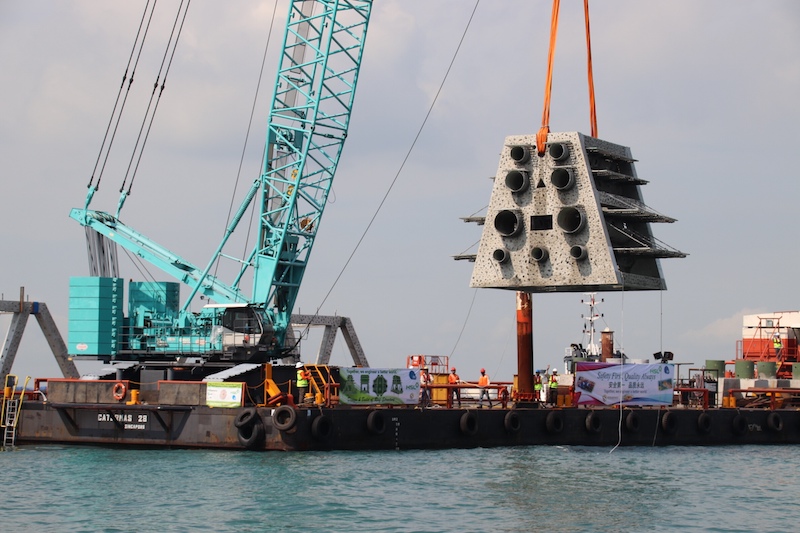
One of the eight reef structures being lowered into the waters off Sisters’ Island Marine Park PHOTO: NATIONAL PARKS BOARD

Over the last five decades, Singapore has successfully built quality high-rise public housing that now houses over 80 percent of its resident population. But increasingly, it is not just people but also animals in the city-state that can proudly claim to live in a home designed for them.

From intelligent nests for hornbills to hotels for bees, the government has been creating structures to help different species thrive in an effort to strengthen Singapore’s biodiversity. One of its newest initiatives is the nation’s largest purpose-built reef within the waters of Sisters’ Islands Marine Park, located just south of the mainland. Five 11-metre and three 6-metre tall structures have been installed on what was previously relatively flat and bare seabed. Akin to three-storey terrace houses, they hope to eventually be home to some 1,000 square metres of reef substrate and other marine life. If successful, this pilot will pave the way for future restoration efforts in Singapore. Over the years, the city-state has lost some 60 percent of its reefs because of extensive development and reclamation over the years.

The government agency JTC first conceptualised this project in 2010 to support efforts in enhancing the city-state’s marine biodiversity, particularly in the face of climate change and increasing coastal developments. While it is better known for the planning and development of Singapore’s industrial infrastructure such as the petrochemical complex, Jurong Island, this was an opportunity for JTC to lend its engineering and design expertise to scale up previous efforts to restore the city-state’s coral reefs.
Read more

In Singapore, Residents Create a Social Distancing Wayfinding Language With Tape

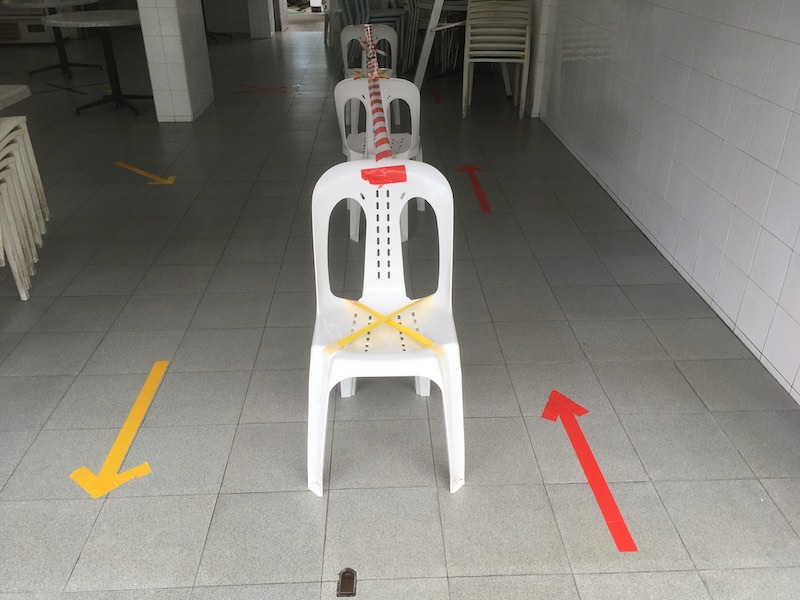
Dots. Lines. Crosses. Boxes. They have popped up all across Singapore over the past few weeks. Plastered over furniture, floors, and more, the city-state renowned for its cleanliness and order has become a maze of symbols, in order to defend its inhabitants from the COVID-19 pandemic.

This “mess” is indeed a series of messages. They tell citizens to stay apart from one another as the city battles to control the spread of the virus. Such makeshift signs started appearing right after the government introduced safe distancing measures on March 20, in order to limit the number of people gathering in a space and keep them at least 1-metre apart.

With just two-days notice before the measures turned into law, and no specific guide on how to implement them, local businesses and organizations quickly found their own solutions. While some printed custom signage to explain the measures, the most popular method has been to use adhesive tape to construct symbols, from crossing out seats to drawing queue lines and cordoning off areas.

➜ Read the full story in AIGA’s Eye on Design

30 Years of Conservation: A Lifelong Commitment

Conservation is a lifelong commitment, says Dr Richard Helfer who still has a soft spot for his first conservation/restoration project – Raffles Hotel.

Walk past Raffles Hotel today and one is struck by its grand façade with a welcoming cast-iron portico that harks back to the early 20th century. But what completes this historic view along Beach Road are four vintage street lamps in front of the Grand Old Lady of Singapore.

“We specially brought them in from Charlottenburg, Berlin, as part of the conservation, restoration and redevelopment of Raffles Hotel and Arcade from 1989 to 1991,” says Dr Richard Helfer.

“We had these conceptual models (of the hotel) and we knew what the front would look like… yet we thought that something did not look right,” recalls Richard. He oversaw the project and Raffles Hotel for 14 years as Founding Chairman and Chief Executive Officer of Raffles International Hotels & Resorts and Executive Director and Chairman of Raffles Hotel.

Typical modern street lights would not fit what he and his team expected to become “the most photographed view in Singapore”. Armed with an early photograph of the hotel showing the desired street lamps, Richard went hunting for lamps similar to those that once stood outside of the hotel at the turn of the century and located them in Berlin.

He had to convince the German city’s mayor to sell four of the lamps, which up to this time were restricted to his city and then seek approval from the Public Utilities Board in Singapore to make an exception.

The lamps were not required by the conservation guidelines for Raffles Hotel. However, Richard went through all the trouble because he was convinced that such details in the immediate streetscape were important in contributing to the aura and experience of Raffles Hotel.

“When you do proper conservation and restoration of a building, you need to have a clear vision,” he says. “Our goal was to create something that Singaporeans and visitors could experience as an important relevant component of the history of Singapore and a national icon for Singaporeans to be proud of.”

➜ Read the full story in 30 years of conservation in Singapore since 1989